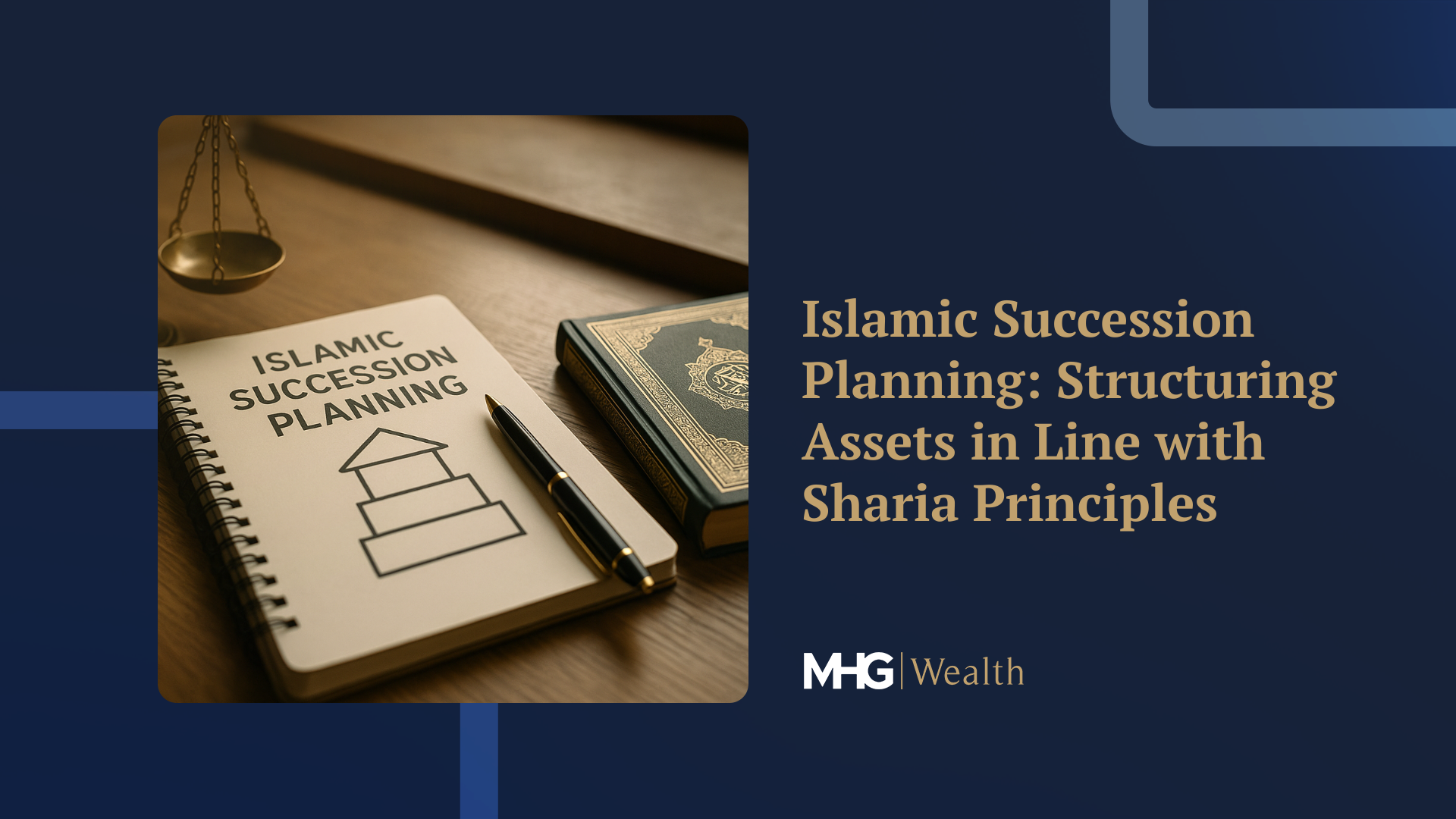
For many families, islamic succession UAE planning is not just about “who gets what” after death—it is about designing ownership, documentation, liquidity and family governance so that wealth transfers smoothly and remains aligned with Sharia values. If you want a wider foundation before you go deep into Sharia-led structuring, this estate planning guide is a helpful starting point.
This article explains how Sharia principles shape inheritance and succession, then turns those principle s into practical steps: how to map your estate, ring-fence family needs, structure assets, and reduce friction for heirs—especially when you have property, businesses, or cross-border holdings.
Why Sharia-led succession planning needs proactive structuring
Sharia inheritance (often referred to as faraid) provides a rules-based framework for distributing an estate to eligible heirs. That clarity can be a strength—but only if your assets are organised and your family understands what will happen.
In practice, avoidable problems usually arise from:
- Illiquid estates (e.g., large property holdings with limited cash to settle obligations).
- Unclear ownership (assets in multiple names, informal family arrangements, missing share registers).
- Cross-border complexity (bank accounts, companies, or real estate in other jurisdictions).
- Family dependency risks (minor children, dependants with special needs, or a non-working spouse).
- Business continuity gaps (no successor plan, no buy-sell arrangements, key person risk).
Planning-led principle: Sharia sets the destination for inheritance distribution; good succession planning designs the route so your family can actually get there without delays, disputes, or forced sales.
Core Sharia concepts that influence inheritance outcomes
You do not need to memorise detailed share tables to plan well, but you do need to understand the levers that are and are not flexible. The summary below is intentionally high-level and planning-oriented.
1) The estate settles obligations before heirs receive anything
Before distribution to heirs, the estate is generally used to settle:
- Funeral and administration expenses (within reasonable bounds).
- Outstanding debts and liabilities.
- Valid bequests (where applicable), then the remainder goes to heirs.
This is why liquidity planning matters: if most wealth is tied up in property or a private business, heirs may face pressure to sell assets quickly to settle obligations.
2) Heirs are defined by relationship and eligibility
Sharia inheritance is a rights-based system for eligible heirs. Broadly, heirs are determined by family relationships (such as spouse, children, parents) and by whether they are legally eligible to inherit. The exact entitlement can vary based on who survives you and the family structure.
3) The wasiyyah (bequest) is limited
A common planning tool is the wasiyyah (bequest). In classical Sharia rules, bequests are typically limited to up to one-third of the net estate and are generally directed to non-heirs (or charitable causes), unless the heirs consent otherwise. This makes the bequest a meaningful tool for values-led planning, but not a substitute for proper asset structuring.
4) Lifetime decisions change what is (and is not) in the estate
What you own at death forms your estate. That seems obvious, but it is the most practical planning insight in this entire topic. Lifetime actions—such as gifting, transferring ownership, changing shareholding structures, or consolidating accounts—can materially change what eventually falls into the inheritance pool.
Because Islamic succession planning should be done carefully and ethically, lifetime transfers should be guided by Sharia principles (including fairness, avoiding harm, and avoiding disputes) and supported by proper legal documentation.
Step 1: Build a clear “estate map” before you restructure anything
Start with clarity, not paperwork. A strong estate map typically includes:
- Assets: UAE and overseas property, bank accounts, brokerage accounts, business interests, crypto/digital assets, collectibles.
- Ownership: sole name, joint name, corporate holding, nominee arrangements (if any), beneficial ownership.
- Liabilities: mortgages, personal loans, credit lines, business guarantees, unpaid taxes abroad.
- Dependencies: minor children, dependants, education commitments, family support obligations.
- Key documents: title deeds, share certificates, shareholder agreements, partnership agreements, loan agreements.
As you map, identify potential “friction points”:
- Assets that would be hard to value or sell quickly.
- Assets held across multiple jurisdictions with different probate rules.
- Businesses without a documented succession or management plan.
Step 2: Separate what is fixed by Sharia from what you can design
A practical way to plan is to create two buckets:
- Sharia-distribution bucket: what is expected to fall into the estate at death and be distributed under inheritance rules.
- Designed-outcome bucket: goals you can address through lifetime structuring, liquidity tools, governance, and documentation (without trying to “override” Sharia).
This mindset helps families avoid two common mistakes: (1) assuming nothing can be planned, and (2) assuming everything can be “fixed” with a single document.
Step 3: Structure ownership thoughtfully (property, portfolios, and family businesses)
Once you know what you own and what you want to achieve, you can start aligning ownership with practical outcomes—while staying true to Sharia principles.
Property: avoid liquidity traps and ownership ambiguity
Real estate is often the biggest UAE asset class in family balance sheets—and also the most common cause of delays. Consider:
- Liquidity planning: Ensure there is enough cash (or readily available liquidity) to cover debts and immediate family needs, so property does not have to be sold under pressure.
- Documented contributions: If family members contributed to a property purchase or mortgage payments, document it clearly to reduce disputes.
- Practical “who manages what” plan: Identify who will manage tenant relationships, maintenance, service charges, and renewals during any transition period.
Investment portfolios: match allocations to family responsibilities
Succession planning is a good moment to check whether the portfolio is built around the family’s real needs—income for dependants, education funding, and inflation protection—rather than only maximising returns. If your investments must remain aligned with Islamic principles, review your approach to Sharia-compliant investing options as part of the wider succession conversation.
Family businesses: plan for control, cashflow, and continuity
Business interests introduce three additional challenges: control, valuation, and continuity. Helpful planning questions include:
- Control: If shares transfer to multiple heirs, how will decision-making work? Who becomes managing director, and under what authority?
- Cashflow: Can the business fund buyouts (if needed) or support dependants without harming operations?
- Continuity: What happens to key client relationships, licences, and bank mandates?
In many cases, families use shareholder agreements, board structures, and documented management succession plans to avoid a “sudden fragmentation” of control while still respecting heirs’ rights.
Step 4: Use Islamic planning tools the right way (bequests, gifts, and charitable goals)
Sharia-led succession planning often includes a mix of ethical intentions and practical implementation. The key is to treat each tool as part of an integrated plan rather than an isolated fix.
Wasiyyah (bequest): align values and close specific gaps
A bequest can help you express values (for example, charitable giving) or address needs not met through standard inheritance outcomes. Because the bequest is typically limited, use it strategically—for example, to support a charitable legacy, or to provide for someone who is not otherwise an heir (subject to the appropriate rules and advice).
Lifetime gifts (hibah): clarity and documentation matter
Lifetime gifting can be appropriate in many family situations, especially when done transparently and fairly. Practically, the risk is not the gift itself—it is poor paperwork, unclear intent, or family members learning about it too late. If you gift, ensure:
- The transfer is legally completed (not just “promised”).
- There is documentation showing what was transferred, when, and why.
- Family communication is handled carefully to reduce future disputes.
Charitable giving: build a legacy without destabilising the estate
Many families want a structured charitable legacy. Rather than relying on ad-hoc giving, consider an intentional plan that fits within the broader inheritance framework and preserves enough liquidity for family obligations.
Step 5: Don’t ignore the “administration layer” (wills, guardianship, and practical instructions)
Even when inheritance distribution is rules-based, your family still has to navigate administration: locating assets, accessing accounts, managing ongoing bills, and caring for dependants. This is where documentation and “operating instructions” reduce stress dramatically.
Wills and written instructions
Depending on your circumstances, a will may help clarify key practical matters (for example, guardianship preferences for minor children, and operational instructions for the family). If you need an overview of how the process and documentation works locally, read this guide on how wills work in the UAE.
For jurisdictional guidance and local procedures, you can also refer to the Abu Dhabi Judicial Department for official information on court services and processes.
Guardianship planning for minor children
Guardianship is often the most emotionally important part of succession planning. Families should discuss (and document, where appropriate):
- Who should be responsible for day-to-day care.
- Who should oversee financial matters for the child’s benefit.
- What education, housing, and support should look like.
Because guardianship can be sensitive and fact-specific, take professional advice and ensure your family understands your intentions.
Step 6: Plan liquidity so heirs are not forced into rushed decisions
Liquidity planning is a practical bridge between Sharia principles and real-world implementation. Common liquidity needs include:
- Settling debts and final expenses.
- Covering immediate family living costs during the transition.
- Funding education commitments.
- Protecting a business while ownership and management stabilise.
Families often keep a dedicated cash buffer, maintain appropriate protections, and structure assets so that at least part of the estate can be accessed or realised without selling long-term holdings under time pressure.
Step 7: Address cross-border assets early (especially for international families)
If you hold assets outside the UAE—or you have heirs living abroad—succession becomes a multi-jurisdiction project. A practical approach is to:
- Create a country-by-country asset list and identify what documents each jurisdiction requires.
- Confirm how ownership is recorded (and whether beneficial ownership differs).
- Check whether overseas taxes or forced-heirship rules may apply.
For a starting point on official local context, the UAE government portal on justice and the law provides general information about legal services and frameworks (your situation may still require specialist advice).
Common mistakes families make in Islamic succession planning
In day-to-day planning, the biggest issues are usually preventable. Watch for these recurring mistakes:
- Assuming a “verbal plan” is enough: If it is not documented and legally effective, it can fail in practice.
- Leaving everything in illiquid assets: This can force distressed sales or create delays.
- Ignoring business continuity: The business may lose value quickly if leadership and bank authority are unclear.
- Not preparing the family: Even the best structure can trigger conflict if heirs are surprised.
- Trying to retrofit at the last minute: Good structuring typically takes time (valuations, legal drafting, family alignment).
A practical checklist for islamic succession UAE planning
Use this checklist as a working agenda for your family and advisers:
- Inventory: Complete an estate map (assets, liabilities, ownership, documents).
- Objectives: Define what “success” looks like (family stability, business continuity, charitable legacy).
- Liquidity: Estimate near-term cash needs (debts, living costs, education, administration).
- Ownership design: Review how property, portfolios and business interests are held.
- Governance: Clarify who makes decisions in a business or family structure and how disputes are handled.
- Documentation: Ensure key agreements and instructions are current and accessible.
- Communication: Decide what to share with heirs now to prevent future disputes.
- Review cadence: Revisit the plan after major life events (marriage, divorce, births, major acquisitions, relocation).
FAQs
Is Sharia inheritance “automatic” in the UAE?
For Muslims, Sharia principles commonly shape inheritance outcomes, but the practical process still involves administration, documentation, and often court procedures. The better your assets and paperwork are organised, the smoother the transfer can be.
Can I decide exactly who gets each asset under Sharia?
Sharia inheritance includes defined heir entitlements, so the distribution of the estate is not purely “choose-your-own.” However, there is still meaningful scope to plan via lifetime structuring, liquidity planning, governance arrangements, and permissible bequests—so your family experiences a workable outcome within the framework.
What matters most for families with property and a business?
Two themes typically matter most: (1) liquidity to avoid forced sales and disruption, and (2) governance to maintain business continuity. Address these early, because they are often harder to fix later.
How often should an Islamic succession plan be reviewed?
At minimum, review after any major life event (births, deaths, marriage/divorce, relocation, business restructuring) and whenever your asset mix changes significantly. A light annual check-in can also help keep documents and asset lists current.
Putting it all together
Islamic succession planning works best when it is treated as a structured project: map the estate, understand what Sharia fixes and what you can design, then align ownership, liquidity, governance, and documentation so your family can transition smoothly. Done well, islamic succession UAE planning can protect dependants, reduce conflict, and preserve the value you built—while staying faithful to Sharia principles.