Sharia-compliant investing in a modern world
Investing isn’t just about numbers; for many, it’s deeply tied to values and beliefs. Sharia-compliant investing offers a financial pathway that blends the principles of Islamic law with modern investment opportunities to grow wealth ethically. Rooted in the values of the Islamic faith and the broader principles of Islam, shariah-compliant investing ensures that financial activities are aligned with religious and ethical standards.
In 2026, sharia-compliant investing has moved firmly into a mainstream part of wealth management. Global investors are increasingly looking for compliant and ethical investment solutions that combine competitive performance with clear Islamic investing principles and strong governance. The growth of shariah-compliant investments has paralleled the development of capital markets in regions like the Middle East and Southeast Asia.
This form of investing is gaining traction, particularly in regions like the UAE and the Middle East, as more investors seek options that align with their faith and values. Compliant investing not only respects Islamic teachings but also emphasises fairness, social responsibility and ethical profit sharing.
In this guide, you’ll see how to:
- Understand shariah-compliant investments and the core rules that govern them
- Choose between different investment options such as stocks, sukuk and funds
- Compare shariah investing with conventional investing so you can decide what belongs in your portfolio
Whether you’re just starting or looking to refine your investment portfolio, this guide provides a clear and practical understanding of sharia-compliant finance.
Understanding Sharia-Compliant Investing And Its Principles
Sharia is a comprehensive legal and ethical system of principles derived from the Quran and the Hadith (sayings and practices of the Prophet Muhammad, peace be upon him). Shariah law provides the legal foundation for these principles, offering ethical and legal frameworks for Muslims, covering everything from personal conduct to financial dealings.
In the context of finance, sharia lays out rules designed to ensure fairness, justice and mutual benefit in transactions. Islamic principles guide the ethical behaviour and financial dealings described, emphasising social responsibility and the importance of aligning financial activities with Islamic values.
For Muslims, adhering to sharia-compliant finance means choosing investments and transactions that honour their faith. Under shariah law, money itself should not be used to generate wealth through interest, but rather through productive investment and risk sharing. For others, it represents an opportunity to engage in ethical and socially responsible investing that avoids exploitative practices, excessive leverage and speculation.
Key principles of sharia in finance
In sharia-compliant finance, there are several core concepts that shape how products are structured and investments are screened.
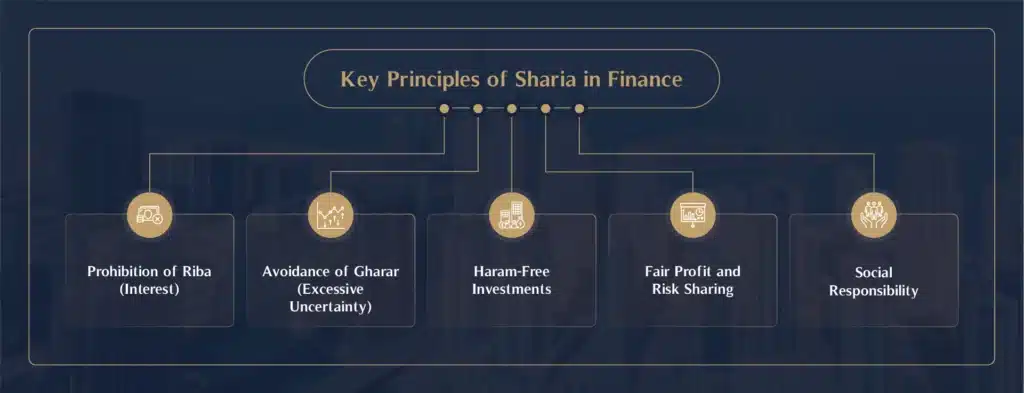
Prohibition of riba (interest) – Interest is strictly forbidden in sharia because it’s seen as exploitative. Charging interest and interest earned are both forbidden under shariah principles, and Islamic banks structure their products to avoid these practices. Instead of earning through interest, investments focus on profit sharing or generating income from tangible assets. Islamic banks agree to share profits and losses with clients, rather than guaranteeing a return to one party, ensuring that no transaction unfairly benefits only one party. Income is linked to underlying business activity rather than a fixed interest coupon.
Avoidance of gharar (excessive uncertainty) – Transactions must be clear and transparent. Sharia prohibits speculative activities or deals involving high levels of uncertainty, such as gambling or highly leveraged trading in complex derivatives. This is why many products that look like pure betting on price movements will not meetshariah compliance tests.
Haram free investments – Investments must steer clear of industries or activities considered harmful or unethical under Islamic law. These include certain industries such as alcohol, gambling, pork production and certain conventional financial services built around interest. A shariah-compliant investment universe is therefore filtered to remove these sectors before any financial screening is done.
Fair profit and risk sharing – Financial dealings should benefit all parties involved. Sharia encourages structures such as Mudarabah (profit-sharing partnerships) and Musharakah (joint ventures), where profits and risks are shared equitably. Profit-sharing arrangements often specify a certain amount or ratio for distribution, in line with shariah law. This focus on partnership is one of the key differences between shariah-compliant equity investing and conventional debt-based finance.
Social responsibility – A portion of wealth should be used to support the less fortunate, reflecting the Islamic principle of zakat (charitable giving). Many funds and investments incorporate this by purifying non-compliant income and directing it to charity. Any impure income or prohibited income generated inadvertently is purified by donating it to charity, as overseen by a shariah board or committee of Islamic scholars and other experts.
The screening process for shariah-compliant investments involves evaluating companies’ cash and receivables, ensuring that cash and accounts receivable do not exceed a certain threshold of total assets. The investment process is overseen by a shariah board, which is composed of Islamic scholars and other experts who review and approve investment products. Shariah-compliant investments can span multiple asset classes, including equity, real estate, and sukuk. All investment products must be approved by the shariah board to ensure ongoing compliance with Shariah principles.
What is prohibited under sharia law?
Sharia places clear restrictions on certain financial activities to ensure ethical practices. In practice, shariah compliance means avoiding three main areas.
First, interest-based earnings (riba) are not allowed. Charging interest is strictly prohibited under shariah law, and any prohibited income, such as earnings from charging or paying interest, must be identified and purified, typically through charitable donations. Charging or earning interest on loans or deposits is forbidden, so shariah-compliant investments are structured around profit and loss sharing or asset-backed returns instead.
Second, speculation (gharar) is restricted. Investments that behave like gambling, or that involve extreme uncertainty or hidden terms, are not permitted. Examples include many highly leveraged derivative trades or contracts where key details are unclear at the outset.
Third, haram industries are excluded. This covers businesses related to alcohol, tobacco, gambling, pork and clearly unethical practices. A shariah-compliant fund will screen out these sectors altogether so that investing remains aligned with Islamic values.
By adhering to these principles, finance aims to ensure that wealth creation is fair, ethical and closely aligned with Islamic values rather than short-term speculation.
Best Shariah-Compliant Investments For 2026
Sharia-compliant investments provide a way to grow wealth ethically while following Islamic rules on riba, gharar and haram activities. The global market for shariah-compliant investments continues to expand, offering more choice than ever. These investments span multiple asset classes, including equities, real estate, and fixed income, each with distinct characteristics and opportunity sets within Islamic finance frameworks.
Some of the most popular shariah-compliant investment types include:
- Sharia-compliant stocks: These are shares in companies that meet sharia guidelines. Businesses involved in permissible activities, such as technology, healthcare and halal food production, are typically eligible. Screening also looks at balance sheet ratios and interest income to maintain shariah compliance.
- Sukuk (Islamic bonds): Unlike conventional bonds that pay interest, sukuk are structured to provide returns through asset-backed income. Sukuk bonds are a key fixed-income asset class in shariah-compliant portfolios, allowing investors to own a portion of the underlying asset and share in its profits or rental income.
- Real estate investments: Properties used for ethical purposes, such as residential or commercial leasing, align well with sharia principles and can be structured as sharia-compliant investment solutions.
- Sharia-compliant funds: Mutual funds or ETFs focused on compliant companies allow investors to diversify their portfolios without compromising their values. Islamic funds are widely used for diversification and professional management, and many investors now use shariah-compliant funds as the core of their investing approach.
- Alternative investments: Innovative products like Fenchurch Legal or MHG Capital offer unique opportunities for growth, catering to both traditional and modern financial goals, provided they’re structured in a way that meets shariah compliance standards.
For many investors, combining equity exposure, sukuk and real assets through a mix of shariah-compliant funds is the simplest route to a diversified investment portfolio.
Sharia-Compliant Stocks And Their Performance
Why shariah-compliant equity can be competitive
Many investors assume that limiting investments to sharia-compliant options reduces the potential for growth. However, the reality is often quite different. Stocks can perform well because they emphasise long-term value, sustainable practices and reduced financial risk.
Stocks undergo rigorous screening to ensure they align with the ethical and financial guidelines of Islamic finance. This typically excludes highly leveraged companies and sectors tied closely to interest-based finance, which can reduce vulnerability during financial crises.
Equity investing also naturally aligns with many global sustainability trends, since the process avoids heavily indebted businesses and industries seen as harmful or speculative.
Examples of sharia-compliant stock indexes
Several major index providers offer benchmarks that track shariah-compliant investing. These are widely used both by investors who want to understand how compliant investments perform over time.
The S&P 500 Shariah Index includes approximately 275 sharia-compliant constituents from the S&P 500. Over the last decade, it has demonstrated competitive performance, averaging an annual return of 14.25% as of March 2024, and during that period, it outperformed the conventional S&P 500, which achieved 12.96% annually over the same timeframe. The index excludes sectors such as traditional banking and instead has heavier weightings in technology and healthcare.
The Dow Jones Islamic Market World Index, established in 1999, features around 4,700 constituents worldwide and focuses on sectors such as technology, healthcare and industrials. It has provided steady returns while aligning with Islamic financial principles, serving as a comprehensive benchmark for global sharia-compliant investments.
The MSCI World Islamic Index, with roughly 370 constituents, filters sharia-compliant large and mid-cap stocks from 23 developed markets. It emphasises technology, energy and healthcare stocks and has consistently provided robust returns similar to its parent MSCI World Index.
Insights on performance and market cycles
Sharia-compliant stocks tend to outperform during economic downturns due to their exclusion of high-risk and heavily leveraged businesses. This approach contributes to risk reduction during periods of market volatility, helping to minimise potential losses when markets are unstable. For instance, during the COVID-19 pandemic, sectors such as technology and healthcare, which are common in sharia-compliant indexes, outperformed traditional industries such as banking and energy.
However, these indexes may underperform in periods when financial and conventional banking stocks thrive, as seen during the banking recovery in 2016. For investors, this reinforces that shariah-compliant investing isn’t automatically better or worse than conventional investing, but it has a different risk and sector profile that can be attractive over a full cycle.
Examples Of Successful Sharia-Compliant Funds
Sharia-compliant funds have carved a niche in the global financial market, attracting both faith-based and ethical investors. Compliant investment funds are specifically designed to meet the needs of both faith-based and ethical investors, including a growing number of Islamic investors worldwide. As interest in shariah-compliant investments has grown, the range and sophistication of compliant funds have expanded too.
HSBC Islamic Global Equity Index Fund
This fund primarily invests in technology, software and pharmaceutical sectors, aligning with Islamic investment principles. It includes 100 of the largest global stocks that meet strict sharia compliance standards. Over the past decade, the fund has shown steady growth due to its focus on high-performing sectors. As of recent reports, it has consistently provided competitive returns against conventional equity funds while maintaining shariah compliance.
Amana Funds (Managed by Saturna Capital)
The Amana range includes products such as the Amana Growth Fund (AMAGX), which focuses on long-term capital growth, and the Amana Income Fund (AMANX), which targets companies with stable dividend payouts.
The Amana Growth Fund achieved a five-year annual return of approximately 15.98% as of 2023, outperforming many conventional counterparts. Its adherence to ethical investment principles makes it a preferred choice among sharia-conscious investors who want professional shariah-compliant investing without having to pick individual stocks themselves.
S&P Dow Jones Shariah indices in fund form
A number of funds and ETFs track S&P Dow Jones Shariah indices. The S&P 500 Shariah Index, launched in 2006, mirrors the traditional S&P 500 but filters out non-compliant companies. With information technology comprising around 38% of its holdings, it has outperformed traditional indices during periods when the tech sector booms, and shariah-compliant funds that track it have benefited from that tilt.
Oasis Crescent Funds
Oasis Crescent funds typically include a blend of equity, sukuk (Islamic bonds) and property investments. The Oasis Crescent Global Equity Fund is known for its diversified global shariah-compliant equity portfolio and has appealed to international investors looking for an actively managed shariah-compliant investment solution.
These examples illustrate that shariah-compliant funds range from index trackers to active strategies, but all apply shariah screening and Islamic investing principles in a systematic way.
Performance Trends In Sharia-Compliant Funds
Sharia-compliant funds have witnessed significant growth over the years, particularly in regions with strong Islamic finance ecosystems. Global assets under management for shariah investments have risen steadily, reflecting both regulatory support and increased investor awareness.
As of 2023, the total assets under management (AUM) for sharia-compliant funds exceeded $120 billion, up from $47 billion in 2008. The Gulf Cooperation Council (GCC) countries and Malaysia are leading the charge, backed by supportive regulation, a growing base of retail and institutional investors and wider interest in Islamic values in investing.
From a performance standpoint, shariah-compliant investing has often tracked global equity markets closely, with periods of outperformance when technology, healthcare and other favoured sectors lead, and periods of relative underperformance when excluded sectors such as conventional banks surge. For long-term investors who value both performance and shariah compliance, this pattern is typically an acceptable trade-off.
Evaluating Sharia-Compliant Finance
How do sharia funds compare to conventional investments?
When placed side by side, sharia-compliant funds often match, and sometimes outperform, conventional investments. There are three main reasons for this.
First, the ethical focus of shariah-compliant funds means they avoid industries prone to extreme volatility or reputational risk. This can contribute to more stable long-term returns.
Second, funds are usually backed by tangible assets rather than speculative leverage. Returns are driven by underlying business performance rather than complex derivative structures, which helps to reduce hidden risks.
Third, the emphasis on responsible, haram free sectors and sustainable balance sheets aligns well with broader trends in ESG and sustainable investing. As a result, shariah-compliant investing can appeal to both Muslim and non Muslim investors looking for a disciplined, values-driven approach.
Key criteria for choosing sharia-compliant investments
Investors should consider the following when choosing sharia-compliant options or building an investment portfolio:
- Certification: Ensure the investment is certified by a reputable sharia board and has clear compliance oversight.
- Transparency: Look for clear and detailed information about how profits are generated, how screening works and how non-compliant income is purified.
- Performance: Evaluate historical returns and risk levels to ensure competitiveness against suitable benchmarks.
- Alignment with values: Confirm that the investment aligns with both your financial goals and your ethical beliefs, including your position on questions such as ‘is trading haram’ in highly speculative markets.
This is as important for compliant trading strategies and funds as it is for individual investments.
Importance of adhering to sharia rules
Adhering to sharia isn’t just about religious observance; it’s about fostering trust, fairness and long-term growth. Investors who follow sharia principles often experience peace of mind knowing their wealth is managed ethically and sustainably.
By choosing sharia-compliant finance, you not only align your investments with your values but also contribute to a financial ecosystem that prioritises fairness, responsibility and ethical growth.
For expats who now live in the UAE, you need to understand more than just how sharia rules impact investing. For more information, read our article on UAE inheritance law for expats.
Why Sharia-Compliant Investing Deserves A Place In Your Portfolio
Sharia-compliant investing isn’t just an option for Muslim investors; it’s a testament to how values-driven investing can foster long-term success. Its emphasis on fairness, ethics and social responsibility makes it an attractive choice for those who want to grow their wealth while staying true to their principles.
As the market for shariah-compliant investments matures, investors have increasing access to compliant equity, sukuk, diversified funds and tailored shariah-compliant ethical investment solutions. That means it’s now far easier to build a fully compliant investment portfolio that doesn’t compromise on professionalism, diversification or performance.
Key takeaways on sharia-compliant investing
- Sharia-compliant investing is built around clear Islamic investing principles such as the prohibition of riba, avoidance of haram sectors and fair risk sharing, creating a values-based framework for long-term wealth building
- A wide range of investments now exists, from individual stocks and sukuk to global funds, giving investors genuine choice without leaving sharia principles behind
- Evaluating shariah-compliant investing carefully, with attention to certification, transparency and performance, allows you to integrate shariah investments into a modern, diversified portfolio that reflects your beliefs
At MHG Wealth, we specialise in crafting personalised financial plans that respect your values and help you achieve your goals. Whether you’re new to sharia-compliant investing or looking to expand your portfolio, our experts are here to guide you every step of the way.
Take the first step today. Contact us to explore sharia-compliant investment solutions tailored to your needs. Together, we can help you grow your wealth ethically and sustainably.
FAQ about Sharia-Compliant Investments In 2026
How can you check if an investment is genuinely shariah compliant?
You can start by looking for a clear shariah compliance certification from a recognised board or advisory firm. Genuine shariah-compliant investments are approved by a shariah board or committee of Islamic scholars, who rigorously review and certify the product to ensure ongoing Islamic compliance. These investments will explain their screening criteria, list excluded sectors and publish details of the scholars or committees who supervise shariah compliance. If you’re in doubt, compare the product with well-known shariah-compliant funds or indexes and ask the provider directly for documentation.
Do shariah-compliant investments always avoid lower performance?
No investment can guarantee performance, and shariah-compliant investing is no different. Shariah-compliant investments may outperform in some periods and lag in others, depending on how excluded sectors such as conventional banking perform. Over longer periods, many shariah-compliant funds have delivered competitive returns, but you should still assess risk, diversification and costs in the same way you would for any other investment.
Is short-term trading allowed in sharia-compliant investing?
Short-term trading isn’t automatically haram, but it raises questions around speculation and gharar. Sharia-compliant trading should avoid gambling-like behaviour, extreme leverage and products that don’t involve real ownership of assets. If you want to trade actively while remaining shariah compliant, focus on investing in real shariah-compliant equity and funds, avoid margin and derivatives where possible and seek guidance from a qualified scholar if you’re unsure.
Can you build a fully diversified portfolio using only shariah-compliant investments?
Yes, you can build a diversified portfolio using only shariah-compliant investments. A typical portfolio might combine shariah-compliant equity funds, sukuk, real estate and carefully structured alternative investments. While the opportunity set is smaller than the full conventional market, sharia-compliant funds and products have grown enough that most investors can achieve sensible diversification within compliant boundaries.
Are shariah-compliant funds only suitable for Muslim investors?
Shariah-compliant funds are designed to meet Islamic investing principles, but they’re open to any investor who values ethical, asset-backed and lower debt investing. Many non Muslim investors use shariah-compliant investment products as part of a broader ethical or responsible investment strategy, because compliance often overlaps with their own values on leverage, speculation and harmful industries.