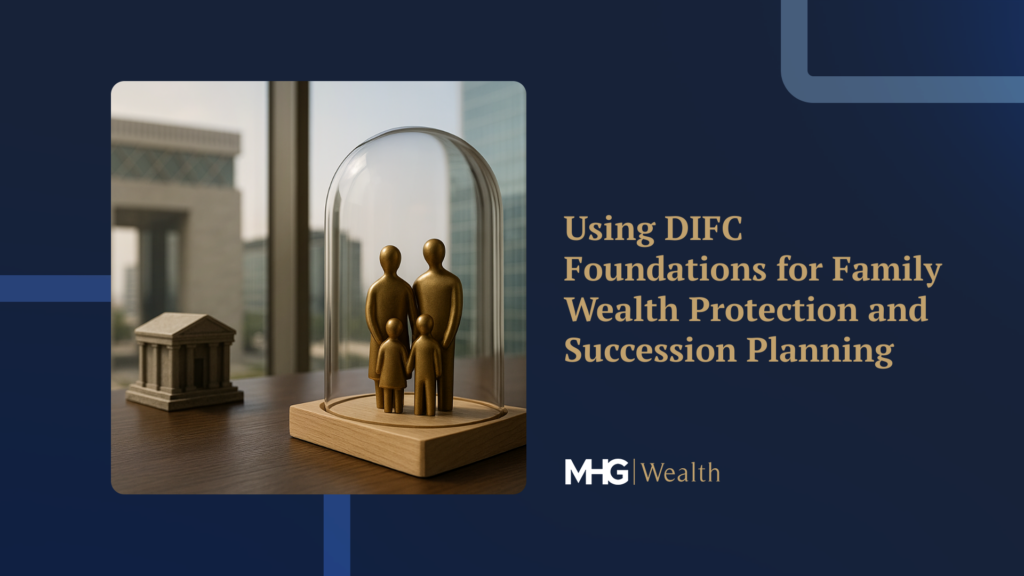
For internationally mobile families, succession planning is rarely just about “who gets what”. It is about keeping control, protecting assets from avoidable risks, and creating a governance framework that works across jurisdictions, family branches and generations. A difc foundation can provide that structure, operating alongside (but clearly separate from) personal wills and probate planning. If you want the broader context first, see our estate planning guide for families with international lives.
This article explains how DIFC Foundations are commonly used to hold family assets, set multi-generational rules and streamline succession outcomes—without relying on a will-centric approach.
What is a DIFC Foundation (and why families use it)
A DIFC Foundation is a legal entity established in the Dubai International Financial Centre (DIFC) that can own assets in its own name. It is typically designed for long-term wealth holding and stewardship: the foundation’s purpose, governance and distribution rules are set out in its constitutional documents, and it continues regardless of changes in family circumstances.
In practical terms, a difc foundation can sit at the centre of a family wealth plan by:
- Holding assets (directly or through underlying companies) to centralise ownership and decision-making.
- Separating control from benefit, allowing a founder to create rules that protect beneficiaries while enabling professional governance.
- Supporting succession by setting pre-agreed processes for future decision-makers and benefit distribution.
For a reference point on the legal source framework, you can review the DIFC legal database for applicable laws and regulations (including the regime governing foundations).
What problems a DIFC Foundation can solve for HNW families
1) Avoiding fragmented ownership across jurisdictions
Many families accumulate assets in different names, countries and structures over time: real estate in one jurisdiction, a holding company in another, investment accounts elsewhere, plus operating businesses. A foundation-led design can consolidate ownership under one “umbrella” with consistent rules, while still allowing local compliance via underlying vehicles where needed.
2) Asset protection through structure and governance
Families often seek protection from foreseeable risks such as forced heirship outcomes in certain jurisdictions, beneficiary divorces, creditor risks, or disputes between family branches. A foundation does not magically remove risk, but it can reduce exposure created by personal ownership by placing assets in an entity with clear governance and decision-making rules.
3) Continuity when family roles change
When a principal dies or loses capacity, personally held assets often face delays, administrative friction and disputes. A DIFC Foundation can maintain continuity because the entity remains in place and control can pass according to pre-defined governance rules rather than ad-hoc family negotiations.
How a DIFC Foundation holds and manages family assets
A difc foundation can be used as a holding vehicle for a wide range of assets. Common examples include:
- Marketable securities and managed portfolios (often via custodian or brokerage arrangements in the foundation’s name).
- Shares in operating companies (directly or via intermediate holding companies, depending on the jurisdiction and commercial requirements).
- UAE and international real estate (subject to local land department rules and structuring considerations).
- Family intellectual property (e.g., trademarks and licensing arrangements) where long-term stewardship is important.
- Collectibles and alternative assets (where documentation, insurance and custody arrangements can be formalised).
Families typically pair the foundation with:
- one or more underlying SPVs (for ring-fencing liabilities, regulatory reasons, or asset segregation);
- a written investment policy and risk framework; and
- formal reporting (for family transparency and to support long-term decision quality).
Governance across generations: the feature most families actually need
The long-term value of a foundation is often less about the “entity” and more about the governance design. High-quality governance can reduce conflict, limit ambiguity and provide a practical mechanism for decision-making as the family expands.
Key roles: Founder, Council and (optionally) Guardian
While exact terminology and design vary by constitution, foundations usually include:
- Founder: establishes the foundation and defines its purpose and rules (often stepping back from day-to-day control over time).
- Council: the governing body responsible for administering the foundation and making decisions in line with its documents.
- Guardian (optional but common): provides oversight and can protect the foundation’s purpose by supervising the Council, particularly where beneficiaries are vulnerable or the family expects future disputes.
Building a “family constitution” without turning it into a court fight
Well-drafted governance provisions can address real-world issues such as:
- who can join the Council and how succession of decision-makers works;
- required voting thresholds for major actions (sale of a core business, leveraging real estate, changing investment mandates);
- rules around distributions: needs-based, incentive-based, milestone-based, or capped; and
- dispute resolution mechanisms, including mediation or arbitration requirements.
For many families, the aim is not to lock everything down forever—it is to create predictable decision pathways and reduce the “grey areas” that trigger conflict.
Succession planning using a foundation (without making it about wills)
It is important to separate succession of control from succession of benefit:
- Control: who makes decisions for the family assets (Council composition, powers, replacement rules).
- Benefit: who can receive distributions, when, and under what conditions (beneficiary classes and distribution policy).
A foundation-based plan can specify both elements clearly, reducing reliance on probate processes for the core asset base. Wills can still play a role for personal assets outside the structure, but the foundation approach is primarily about owning and governing assets during life so that death or incapacity does not disrupt stewardship.
Where families have exposure to multiple legal systems, the planning conversation also needs to acknowledge the practical impact of local inheritance rules. If this is relevant to your family, our overview of UAE inheritance law considerations for expats provides a useful starting point.
When a DIFC Foundation is especially useful
Family business succession
For founder-led businesses, the transition risk is often operational rather than purely legal: who can appoint management, approve strategy, and handle dividend policy when the founder is no longer at the centre. A foundation can hold shares and specify governance so the business is not forced into rushed restructures during emotionally difficult periods.
Cross-border family assets and beneficiaries
As soon as assets, family members, or tax residency locations span multiple jurisdictions, planning becomes a coordination exercise. A foundation can serve as the “hub” for consolidated governance while local advisers manage the “spokes” (property ownership rules, corporate compliance, account opening requirements and tax reporting).
If your family’s balance sheet includes multiple countries, this is closely linked to broader cross-border structuring and planning. For a deeper look at how families approach this, see estate planning for families with cross-border assets.
Second marriages, blended families and unequal wealth creation
Blended-family dynamics can create genuine planning tensions: fairness versus equality, protection for a spouse versus preservation for children from a first marriage, or support for vulnerable beneficiaries without exposing the wider estate. A foundation can hard-code a policy framework so expectations are clear long before a triggering event occurs.
How a DIFC Foundation differs from a trust (and from a will)
Foundation vs trust (high level)
Both can be used for wealth holding and succession outcomes, but the “architecture” differs. A foundation is an entity with governing bodies; a trust is a legal relationship where trustees hold property for beneficiaries. Some families prefer the entity-style governance and the optics of an institutional holding vehicle; others prefer trust traditions and trustee duties. The choice often comes down to family preference, adviser experience, asset location and governance complexity.
Foundation vs will (the key distinction)
A will is primarily a document that instructs what should happen to assets at death, and it often depends on probate or similar court/administrative processes. A foundation structure is designed to own assets during life and to continue seamlessly across generations based on its internal governance. In other words, wills can complement the plan, but a foundation is a structural solution for long-term stewardship.
Important: a foundation is not a “set-and-forget” substitute for legal and tax advice. Families should model outcomes, confirm local enforceability, and coordinate with all relevant jurisdictions before transferring significant assets.
Implementation roadmap: setting up and running a DIFC Foundation
Step 1: Define objectives and success metrics
Start with clarity: is the priority asset protection, governance, a business succession plan, privacy, long-term philanthropy, or beneficiary support? The constitution can only do its job if it is built around real objectives.
Step 2: Map assets, liabilities and control points
This includes identifying where assets sit, in whose name, which banking platforms are used, what debt is attached, and who holds the current decision-making power. Many issues arise not from the legal structure but from incomplete asset transfer and poor documentation.
Step 3: Design governance and distribution rules
Governance should be designed for “future you” and “future family members” who may not agree. Establish clear rules for Council appointment, removal, reserved matters, reporting, and conflicts of interest. Distribution rules should match family values and practical needs, and should be coordinated with tax and residency considerations.
Step 4: Transfer assets and operationalise reporting
Once set up, the foundation must actually receive ownership of the assets (or of the entities that own them). This is often the most time-consuming stage due to bank onboarding, KYC, corporate registries, land department processes and cross-border legal steps.
Step 5: Review cadence and governance upgrades
Families evolve. A robust plan includes a review timetable (e.g., annually, and upon major life events) and a controlled mechanism for amendments, so the foundation remains aligned with the family’s reality.
Common pitfalls to avoid
- Unclear roles: if family members do not understand who decides what, disputes become almost guaranteed.
- Overly rigid distribution provisions: rules should prevent misuse but still allow for genuine future needs and emergencies.
- Incomplete asset transfer: a foundation that “exists on paper” but does not own the meaningful assets will not deliver continuity.
- Ignoring cross-border tax and reporting: the best structure can be undermined by non-compliance in a single jurisdiction.
- Confusing estate documents with structure: a will can be vital, but it is not a governance system for complex family wealth.
Conclusion: a structure-led approach to family wealth continuity
A difc foundation is best understood as a long-term ownership and governance platform for family assets—designed to protect, professionalise decision-making, and create predictable succession outcomes across generations. For HNW families with international complexity, it can be the difference between a wealth plan that looks good on paper and one that actually functions when life changes.
FAQs
Is a DIFC Foundation only for very large families?
Not necessarily. It is most compelling when governance complexity is high: multiple jurisdictions, business assets, multiple family branches, or a need for ongoing stewardship. For simpler estates, the cost and complexity may outweigh benefits.
Can the founder still control decisions?
Control is a design choice. Many founders retain significant influence initially (for continuity) and then plan an orderly transition to a more independent Council or professional governance model over time.
Can a foundation own UAE property and company shares?
Often yes, but the practical answer depends on the asset type, jurisdiction, and the relevant registry or counterparty requirements. Many families use underlying SPVs to meet local rules and ring-fence liabilities.
Does a foundation remove all inheritance-related risks?
No. It can reduce certain practical and legal risks by moving assets out of personal ownership and into a governed structure, but outcomes still depend on implementation quality, asset location, and proper legal and tax coordination.