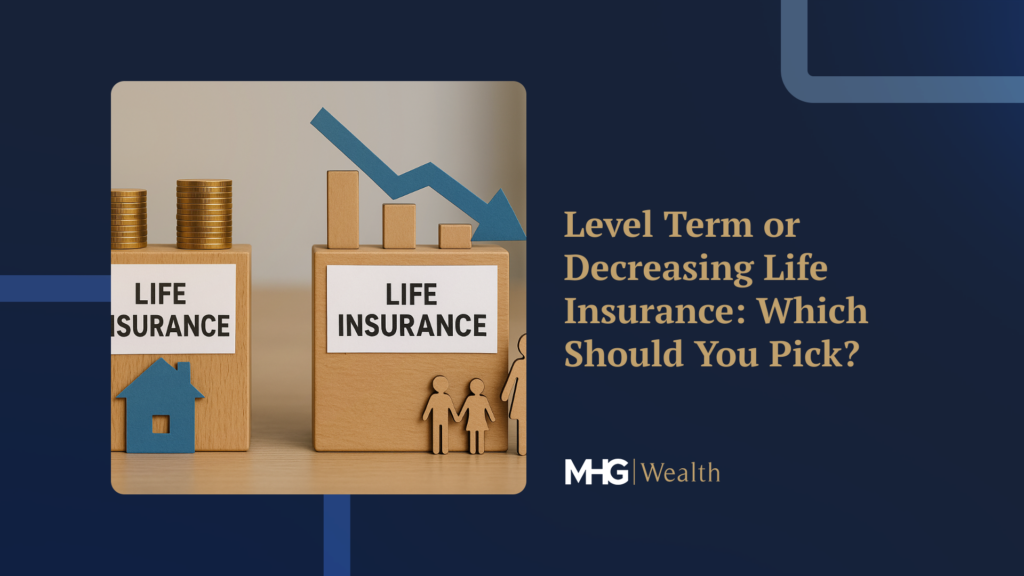
If you’re comparing level term or decreasing life insurance, the simplest way to decide is to match the policy to what you’re protecting: a family’s ongoing lifestyle needs (typically level term) or a specific debt that shrinks over time (typically decreasing term). If you want a broader refresher on how protection policies work, start with this guide to term life insurance in the UAE.
Below is a practical, side-by-side comparison (with quick examples) so you can choose based on real-world liabilities and dependants, not just jargon.
What each policy is designed to do (in plain English)
Level term life insurance
A level term policy pays a fixed lump sum if you die during the term (e.g., 20 or 25 years). The cover amount stays the same throughout.
Designed for: dependants who need a stable financial cushion for income replacement, school fees, rent, and everyday living costs.
Decreasing term life insurance
A decreasing term policy pays a lump sum that reduces over time (often in line with an amortising repayment schedule). The idea is that your insurance falls as your debt falls.
Designed for: a specific liability that is expected to reduce predictably, most commonly a repayment mortgage.
Level term vs decreasing term: side-by-side comparison
| Feature | Level term | Decreasing term |
|---|---|---|
| Benefit amount | Stays the same for the whole term | Reduces over time |
| Best matched to | Income replacement, family costs, school fees, general protection | Repayment mortgage or other reducing debt |
| Typical use case | “If I’m not here, my family can maintain their lifestyle and plans.” | “If I’m not here, the outstanding mortgage can be cleared.” |
| Premiums | Often higher than decreasing term for the same start cover and term | Often cheaper because the insurer’s maximum payout reduces over time |
| Inflation impact | Fixed cover may buy less in the future unless you plan for inflation | Cover shrinks while costs can rise, so it can under-protect non-debt needs |
| When it can fall short | If you only needed to cover a shrinking mortgage and overpaid for cover | If your family needs ongoing income support beyond clearing the debt |
Match the policy to your liability (what you’re actually trying to protect)
Choose level term if the “problem” is ongoing living costs
Level term is usually the better fit when the financial loss would be ongoing, such as replacing a parent’s income for a number of years.
- Dependants: young children, a non-working spouse, or dependants with long-term needs
- Costs you’re covering: rent, school fees, childcare, household bills, day-to-day spending
- Time horizon: often until children are financially independent or until planned retirement
Quick example: You want a policy that pays AED 2,000,000 at any point over 25 years so your family can invest or budget the money to replace income and cover life costs. That’s a level term goal.
Choose decreasing term if the “problem” is a single reducing debt
Decreasing term is usually the better fit when the main objective is to clear a repayment mortgage so your family can stay in the home without the debt burden.
- Dependants: may still exist, but the largest risk is “can they keep the house?”
- Costs you’re covering: outstanding mortgage balance (often the biggest household liability)
- Time horizon: aligned to the mortgage term
Quick example: You take a 20-year repayment mortgage, and you want the insurance payout to broadly mirror the falling balance. Decreasing term is built for that.
If your goal is specifically mortgage protection, you may also find this guide useful: mortgage life insurance explained.
Practical decision shortcuts (for busy readers)
Rule of thumb: If you’re insuring a person’s income and future plans, lean level term. If you’re insuring a debt that shrinks on schedule, lean decreasing term.
Three quick checks help confirm your direction:
- What must be paid immediately? (Mortgage balance? School fees? Outstanding loans?)
- What must be paid every month? (Rent, bills, childcare, medical costs)
- How long do dependants need support? (5 years, 15 years, to retirement?)
How they work with different family setups
Single income household with young children
Level term often fits best because the financial impact is not just the mortgage. Day-to-day costs and education can run for many years, and those costs don’t “decrease” neatly.
Dual income household with a large repayment mortgage
A common approach is:
- Decreasing term to cover the mortgage balance; and
- Level term for additional family income protection (even a smaller amount can help)
This avoids being “house rich but cash poor” after a claim (mortgage cleared, but income still missing).
No children, but shared financial commitments
If your main goal is protecting a partner from taking on a large debt alone, a decreasing term policy aligned to the debt can be efficient. If you also want to leave a fixed legacy or cover broader obligations, level term can make more sense.
Cost considerations (and why cheaper can be misleading)
Decreasing term is often cheaper because the insurer’s maximum possible payout reduces over time. That’s good value if your need truly reduces (like a repayment mortgage).
Level term can cost more, but it’s designed to deliver the same payout even late in the policy term—exactly when dependants may still need support.
When reviewing quotes and disclosures, it can help to cross-check basic terminology and policy features using an impartial source such as MoneyHelper’s guidance on life insurance.
Common mistakes when choosing between level and decreasing cover
- Using decreasing term to cover income replacement: the cover may drop while family costs don’t.
- Assuming the mortgage is the only risk: many families also need cash flow for living costs, education, and relocation.
- Ignoring inflation: even level cover may need to be larger than you think if you want it to last.
- Not aligning the term length: choosing 15 years when your dependants need 25 years of support can leave a gap later.
- Not coordinating beneficiaries and cross-border planning: especially relevant for expat families with assets and family in more than one country.
For expats, beneficiary choices and succession rules can affect outcomes. If you have cross-border considerations, it’s worth understanding UAE inheritance law for expats as part of the wider protection plan.
How to choose in 5 minutes: a simple checklist
Work through these in order:
- List your liabilities: mortgage, personal loans, business debts, school fees, planned big expenses.
- Separate “reducing debts” from “ongoing costs”: this usually points to decreasing vs level needs.
- Pick the term length: mortgage end date, or the date your dependants become financially independent.
- Stress-test the plan: would the payout still work if investment returns are lower and costs rise?
- Confirm affordability: the best policy is one you can keep in force consistently.
FAQs
Is decreasing term life insurance only for mortgages?
It’s most commonly used for repayment mortgages, but it can also match any liability that predictably reduces over time. The key is that the debt should shrink on a schedule similar to the policy’s decreasing benefit.
Is level term better for families?
Often, yes—because family needs like income replacement and education costs usually don’t fall neatly each year. Level term is typically the straightforward choice when dependants need a stable safety net.
Can I have both level and decreasing term?
Yes. Many households blend them: decreasing term to clear the mortgage, plus level term to provide a cash buffer for dependants and everyday living costs.
What term length should I choose?
Match the term to the period the risk exists: mortgage end date for debt cover, or the years until children are independent / retirement for income replacement. If you’re unsure, a conservative approach is to choose a term that slightly outlasts the need rather than one that ends too early.
Bottom line: which should you pick?
If you’re deciding between level term or decreasing life insurance, start with the liability: use decreasing cover for a shrinking repayment debt (especially a mortgage) and use level cover for dependants who need ongoing financial support. If you have both needs, combining the two can be the most practical way to balance protection and cost.