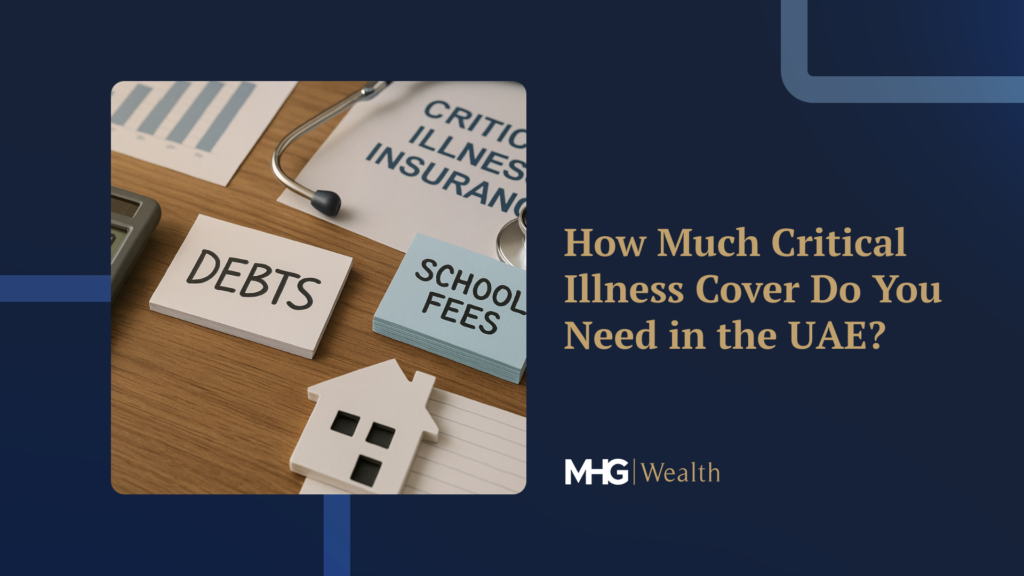
Working out how much critical illness cover you need in the UAE is easiest when you treat it as a cash-flow problem: how many months of essential costs would your household need covered if you couldn’t work, and which large bills would you want cleared or funded at the same time? If you don’t already have a clear monthly number, start by mapping your baseline spending using this beginner’s guide to budgeting so your cover is based on real figures rather than guesswork.
This article is deliberately numbers-led. It gives you a practical framework you can use to estimate an appropriate lump-sum benefit (in AED) based on income, debts, school fees, rent and a realistic recovery timeline.
Step 1: Choose the “recovery period” your cover must fund
Critical illness policies usually pay a lump sum on diagnosis of a covered condition (subject to the policy definition and survival period). The question is: how long might you need financial breathing room before income returns to normal?
A practical way to model this is to pick one of three planning horizons:
- 6 months: you have strong employer sick pay, a working spouse covering most costs, and meaningful emergency savings.
- 12 months: a common middle ground for many UAE expat households.
- 24 months: higher-confidence buffer for single-income families, commission-based roles, business owners, or households with high fixed costs (rent, school fees, loans).
If you are unsure, run the calculation for 12 months and 24 months and compare premiums against the risk of being under-covered.
Step 2: Calculate your monthly “essential spend” (AED)
Use a conservative, essentials-only monthly number. This avoids over-insuring and keeps the estimate realistic.
For most UAE households, essentials often include:
- Housing: rent or mortgage payment
- Utilities: DEWA/ADDC, cooling, internet/mobile
- Food and household
- Transport: fuel, car loan, insurance
- School fees (if you intend to keep children in the same school)
- Debt repayments: personal loans, credit cards, other commitments
- Basic insurance premiums: health top-ups, life/CI premiums if you intend to maintain them
Tip for parents in Dubai: use actual term-by-term fee schedules rather than estimates, and sanity-check them against KHDA’s official resources for parents when you’re reviewing school cost assumptions.
Step 3: Subtract income that would still continue
Don’t automatically insure your full salary. Instead, subtract the cash that is likely to continue during recovery, such as:
- Employer sick pay (if contractually guaranteed and for how long)
- Spouse/partner net income you can rely on
- Cash savings you are willing to use (emergency fund)
- Other predictable income (e.g., contracted rental income)
Be cautious with assumptions: commission, bonuses and business distributions can reduce sharply during a prolonged illness.
Step 4: Apply the core formula (your “income replacement” block)
Use this straightforward calculation:
Income-replacement need (AED) = (Essential monthly spend − Continuing monthly income) × Recovery months
This is the backbone of deciding how much critical illness cover makes sense for your household.
Step 5: Add one-off costs you’d realistically face in the UAE
Critical illness is not only about lost income. Consider adding a realistic buffer for one-off costs that often show up in real life:
- Medical out-of-pocket: deductibles/co-pays, out-of-network bills, medicines not fully covered
- Rehabilitation and support: physio, home care, childcare support
- Travel and logistics: family flights, temporary accommodation, repatriation-related costs if relevant
- Work transition costs: retraining, reduced hours, or a temporary drop in earning capacity
Even with employer-provided health insurance, gaps can exist depending on your network, limits and pre-authorisation requirements. For a neutral overview of how health insurance works across the UAE, see the UAE Government portal guidance on health insurance.
Step 6: Decide what to do about debt (keep paying vs. clear it)
Debt is where cover levels can diverge sharply. You have two common approaches:
Option A: Fund repayments during recovery (lower lump sum)
Include monthly loan repayments inside “essential spend” and cover them for 12–24 months. This is often the cheapest way to insure while still protecting cash flow.
Option B: Clear specific debts on diagnosis (higher lump sum)
Add the outstanding balance of the debt(s) you’d want eliminated (for example, a personal loan or credit card balance). For mortgages, some households prefer to clear the mortgage to remove the biggest fixed cost and reduce stress. If you’re thinking about how different protection policies interact with a home loan, this guide on mortgage life insurance and when it actually helps can be a useful reference point for structuring protection logically.
There’s no universal “right” answer. The choice depends on your risk tolerance, dependants, job security and how quickly you could realistically return to work.
Step 7: Add education costs (if they are non-negotiable for your family)
If school fees must continue, treat them like rent: a fixed commitment that can stress cash flow quickly. You can model school fees in two ways:
- Cash-flow method: add monthly-equivalent school fees into essential spend and cover for 12–24 months.
- Bridge method: add one full academic year of fees as a one-off buffer, if a diagnosis would likely disrupt your ability to pay in a lump.
For many UAE expat families, covering at least one school year can prevent forced school moves at the worst possible time.
Putting it together: a worked example (AED)
Assume a household in Dubai with one main earner and one child:
- Rent: AED 11,000/month
- Utilities, food, transport: AED 7,000/month
- School fees (monthly equivalent): AED 4,000/month
- Loan repayments: AED 3,000/month
- Essential spend: AED 25,000/month
- Continuing spouse income: AED 8,000/month
- Guaranteed employer sick pay: AED 0/month (assume not reliable)
- Gap to insure: AED 17,000/month
Scenario 1: 12-month recovery
- Income-replacement block: 17,000 × 12 = AED 204,000
- One-off medical/rehab/travel buffer: AED 50,000
- Estimated cover target: AED 254,000
Scenario 2: 24-month recovery
- Income-replacement block: 17,000 × 24 = AED 408,000
- One-off medical/rehab/travel buffer: AED 75,000
- Estimated cover target: AED 483,000
Scenario 3: 24-month recovery + clear a AED 200,000 personal loan
- Base (Scenario 2): AED 483,000
- Debt clearance: AED 200,000
- Estimated cover target: AED 683,000
These numbers won’t be perfect, but they are far more useful than rules of thumb (like “X times salary”) because they reflect your actual UAE cost base and commitments.
Sanity checks to avoid over- or under-insuring
1) Don’t double-count the same cost
If you decide to clear a loan in the lump sum (Option B), remove the monthly repayments from the “essential spend” line, otherwise you are insuring the same liability twice.
2) Be realistic about savings you can actually use
It’s tempting to subtract your full bank balance. In reality, most people only want to “spend down” a portion of savings. Decide the amount you’re genuinely comfortable allocating to recovery and leave the rest as a separate resilience buffer.
3) Consider your end-of-service benefit (but don’t rely on it)
Some expats assume an end-of-service payout will solve the problem. But eligibility and payout timing depend on employment status, and illness can complicate plans. If you want to factor it in, understand what counts and how it’s calculated using this guide to end-of-service benefits in the UAE, and then only apply a conservative portion to your model.
4) Add a margin for inflation and cost creep
Medical support, home help, and specialist schooling support can cost more than expected. A 10%–20% contingency on your total target is often a practical buffer if your budget allows.
A simple framework you can reuse (quick checklist)
- Pick recovery months: 6 / 12 / 24
- Essential monthly spend: rent/mortgage + utilities + food + transport + school + debt + basics
- Subtract continuing income: spouse income + reliable sick pay + income you can depend on
- Multiply: monthly gap × months
- Add one-offs: medical gaps + rehab + childcare + travel
- Debt decision: cover repayments or clear balances (but not both)
If you apply this method consistently, you’ll end up with a cover number you can defend logically when comparing policy quotes and benefit levels, rather than relying on generic multiples of salary.
FAQs
Is 12 months of cover enough in the UAE?
It can be if your household has a second reliable income, low fixed costs, and a strong savings buffer. If you are single-income, have high rent/school fees, or your income is variable (commission/business), 24 months is often a more robust planning assumption.
Should critical illness cover match my mortgage balance?
Only if your goal is to clear the mortgage on diagnosis. Many people prefer a lower lump sum that funds repayments for 12–24 months instead, especially if the mortgage balance is large and clearing it would make premiums much higher.
Does critical illness cover replace health insurance?
No. Health insurance pays medical bills within policy limits and rules, while critical illness cover is typically a lump sum you can use for income replacement and wider costs (subject to policy terms).
How often should I recalculate how much critical illness cover I need?
Revisit it when your rent/mortgage changes, you take on new debt, your child’s school fees step up, your income structure changes (e.g., more commission), or you have a new dependant. A simple annual review also helps keep the number current.
What’s a sensible minimum if I want a starting point?
A practical baseline is enough to cover your monthly essential gap for 12 months plus a modest one-off medical/rehab buffer. From there, adjust up if your household is single-income, has high fixed costs, or would struggle to reduce spending quickly.
Ultimately, deciding how much critical illness cover you need is about protecting the months where cash flow is most fragile. If you build your number from essentials, fixed commitments, and a realistic recovery period, you’ll arrive at a cover level that fits your life in the UAE.