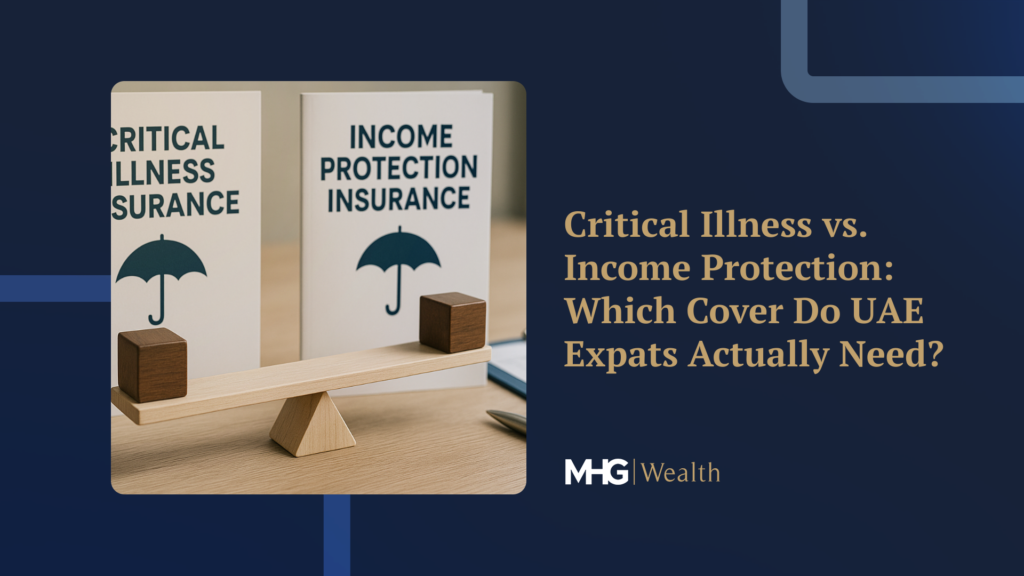
For many expats, the real question behind critical illness vs income protection is simple: “If something happens to me, will my family be able to keep paying the bills in the UAE?” Employer medical cover may pay hospital costs, but it usually doesn’t replace your salary, and End of Service Benefits in the UAE are rarely enough to carry a household for long. This guide compares what triggers each policy, how payouts work, and when one policy might be sufficient versus when combining both can be sensible.
What each policy is designed to do (in one sentence)
Critical illness cover is built to pay a lump sum after you are diagnosed with a specified serious illness.
Income protection is built to replace a portion of your income if you cannot work due to illness or injury (often including mental health, depending on the plan).
Why the difference matters for UAE expats
UAE expats often face a “double exposure” that makes the policy choice more consequential:
- Residency and employment are linked: if you can’t work for an extended period, income risk can turn into visa and relocation risk.
- Costs can stay high even when income stops: rent, school fees, loan repayments and family support back home don’t pause automatically.
- Employer benefits can be limited: sick pay policies vary widely, and group schemes may end when employment ends.
- Medical insurance is not income insurance: even strong health insurance typically doesn’t cover lost earnings. (For context, see UAE government guidance on health insurance.)
Critical illness vs income protection: the 3 differences that decide everything
1) What triggers the claim
Critical illness usually pays when you are diagnosed with a listed condition (for example: cancer, heart attack, stroke). The exact definition matters: insurers pay based on the policy wording, not the label your doctor uses.
Income protection usually pays when you are medically unable to perform your job (or any job, depending on definition). The claim trigger is about functional ability to work, not whether a named illness appears on a list.
2) How the benefit is paid
Critical illness is typically a one-off lump sum. You can use it for anything: treatment abroad, paying off debt, funding a return home, hiring help, or replacing income while you recover.
Income protection is typically a monthly benefit (often a percentage of income) paid after a waiting period, continuing while you remain unable to work (subject to the policy’s maximum benefit period).
3) The purpose (what problem it solves)
Critical illness is best thought of as “capital at a bad time.” It’s designed to help you absorb a major shock: a diagnosis that often brings extra costs and big life decisions.
Income protection is “cashflow continuity.” It’s designed to keep your lifestyle and commitments stable month-to-month if you can’t earn.
Side-by-side comparison (quick reference)
| Feature | Critical illness cover | Income protection |
| Claim trigger | Diagnosis of a specified condition meeting the insurer’s definition | Unable to work due to illness/injury (definition may be “own occupation” or “any occupation”) |
| Payout style | Lump sum | Monthly income replacement |
| Waiting period | Often a short survival period (e.g., must survive 14–30 days after diagnosis, wording varies) | Commonly 30/60/90/180 days before payments start (choice affects premium) |
| How long it pays | Once (some plans have partial/multiple claims; depends on design) | Until recovery or end of benefit period (e.g., 2 years, 5 years, or to a chosen age) |
| Best at covering | Debt payoff, treatment choices, relocation costs, large one-off expenses | Rent, school fees, day-to-day bills, maintaining savings/investments |
| Common gaps | Not all illnesses are covered; must match strict definitions | May not cover redundancy/business downturn; claims depend on medical evidence and policy definitions |
When critical illness cover is usually the better fit
Critical illness cover can be especially useful for UAE expats when the financial risk is less about month-to-month bills and more about the big financial decisions you might face after a diagnosis.
- You want the option to stop working temporarily and focus on treatment without depleting investments.
- You have large liabilities (personal loans, credit cards, or a mortgage) and a lump sum could clear or reduce them.
- You may choose treatment abroad or want funds for travel and family support.
- Your income is variable (bonuses/commission): some people prefer a lump sum rather than relying on a monthly benefit calculation.
When income protection is usually the better fit
Income protection tends to be the “boring but vital” cover because many real-world scenarios are about not being able to work for months (or years) rather than receiving a single dramatic diagnosis.
- Your household depends on your monthly income to cover rent, utilities and school fees.
- You have limited emergency savings relative to your outgoings.
- Your main risk is being off work due to back problems, stress, complications, or injury (not all of which would be a critical illness claim).
- You want a policy that aligns to cashflow: monthly benefit can be easier to budget than a lump sum.
Common misunderstandings (and how to avoid them)
“If I get cancer, both policies pay.”
Not necessarily. A critical illness policy may pay if the cancer meets the definition (and sometimes severity thresholds). Income protection may pay if the condition stops you working beyond the waiting period. You could have one pay and the other not, depending on the situation and wording.
“My employer benefits make this unnecessary.”
Employer sick pay and group insurance can be helpful, but the UAE market is highly varied by employer and contract. Also, group cover may not be portable if you change jobs. Individual policies are designed to follow you, not your employer.
“Health insurance replaces income.”
Health insurance typically covers eligible medical costs. It doesn’t usually pay your rent or school fees while you recover. That’s why income replacement planning sits alongside medical cover.
“The definitions are just legal wording.”
Definitions are the product. For example, “own occupation” vs “any occupation” in income protection can dramatically change claim outcomes. If you’re unsure of terms, use a reference like this plain-English insurance and finance terms guide before comparing providers.
The UAE expat angle: what to consider before choosing
Your emergency fund and waiting period
Income protection won’t usually start paying immediately. The longer the waiting period, the cheaper the premium tends to be, but the more cash reserves you need. Many expats informally use an emergency fund to “self-insure” the first 1–3 months and buy income protection for longer absences.
How long you could realistically stay in the UAE without working
Beyond pure finances, consider practicalities: visa status, dependants’ schooling, and whether you’d relocate for family support. A lump sum critical illness payout can give flexibility; income protection can sustain you if you remain resident and off work for an extended period.
Debt structure and dependants
If you have dependants and long-term liabilities, your protection planning often needs more than one layer. Some expats pair critical illness with term life insurance in the UAE so there is a clear plan for both “can’t work” and “worst-case” outcomes.
When one policy may be enough (simple rules of thumb)
When critical illness alone may be enough
- You have strong savings/investments that could cover 6–12+ months of living costs.
- You primarily want a capital injection to fund choices (treatment, travel, debt reduction).
- Your employer provides robust long-term disability benefits (and you’ve verified the terms).
When income protection alone may be enough
- Your biggest risk is losing monthly earnings rather than needing a large lump sum.
- You have minimal debt or you could manage it from monthly benefit payments.
- You’re comfortable that a major diagnosis would still be covered through income replacement and savings (and you don’t need a “choice fund”).
When having both policies can be sensible
Many UAE expats find that combining the two provides a more complete safety net: the lump sum handles the immediate shock and big expenses, while the monthly income keeps the household stable if recovery takes longer than expected.
- You have dependants and fixed commitments (school fees, rent, loans) and you also want the option to reduce debt quickly.
- You work in a specialised or high-pressure role where returning to work may take time, even after treatment.
- You have cross-border obligations (supporting parents, property abroad) where a single lump sum may not be enough to cover a prolonged absence.
Decision framework: If a health event would mainly cause a cashflow problem, prioritise income protection. If it would mainly cause a capital and life-choice problem, prioritise critical illness. If it would clearly cause both, consider combining them.
How to compare policies (what to ask before you buy)
For critical illness cover
- Condition list and definitions: Which illnesses are covered, and what severity thresholds apply?
- Partial payments: Are there early-stage or partial claims for less severe conditions?
- Survival period: Is there a required survival period after diagnosis?
- Worldwide coverage: Does cover apply if diagnosis/treatment happens outside the UAE?
For income protection
- Occupation definition: Is it “own occupation” or “any occupation” (or a hybrid)?
- Waiting period and benefit period: How long before payments start, and how long can they continue?
- Benefit calculation: How is income defined for employees vs self-employed vs commission-based earners?
- Exclusions and limitations: How does the policy treat pre-existing conditions and mental health claims?
Practical examples for UAE expats
Example 1: Single professional, high savings rate
If you have 9–12 months of expenses in cash and few liabilities, you might lean towards critical illness for flexibility, or choose income protection with a longer waiting period as a cost-efficient backstop.
Example 2: Family with school fees and a mortgage
Households with fixed monthly commitments often prioritise income protection first. Adding critical illness can make sense when you also want to clear debt or create options for treatment abroad without derailing long-term wealth plans.
Example 3: Self-employed consultant or business owner
Income volatility can make benefit calculations more complex. You may need careful structuring to ensure income protection reflects real earnings, while critical illness provides a straightforward lump sum to stabilise the business and personal finances.
FAQs
Is critical illness cover the same as disability cover?
No. Critical illness cover is typically diagnosis-based and pays a lump sum for listed conditions. Disability-style income protection is capacity-to-work based and pays a monthly benefit if you can’t work due to illness or injury.
Can I claim income protection and still work part-time?
Some policies include partial or proportionate benefits when you return to work gradually, but it depends on the contract terms and how “disability” is defined. Always check the wording and ask for examples.
Do these policies replace the need for life insurance?
Not usually. Critical illness and income protection focus on living benefits (you’re alive but unable to work, or dealing with a serious diagnosis). Life insurance is designed for dependants and liabilities if you die during the term.
What’s the biggest mistake UAE expats make when choosing between them?
Buying a policy based on name alone, without checking the definitions and payout structure. The fine print determines whether the policy solves your actual risk: capital shock, cashflow interruption, or both.
Bottom line
In the critical illness vs income protection debate, there isn’t a universal winner for UAE expats. The right answer depends on what would break first in your finances: your ability to keep paying monthly commitments, or your ability to absorb a major one-off shock and make expensive choices.
If you want a clean way to decide, start by mapping: (1) your non-negotiable monthly costs, (2) how many months of expenses you can cover from accessible cash, and (3) what a serious diagnosis would force you to pay or change quickly. That clarity makes it much easier to choose one policy, or layer both for complete protection.