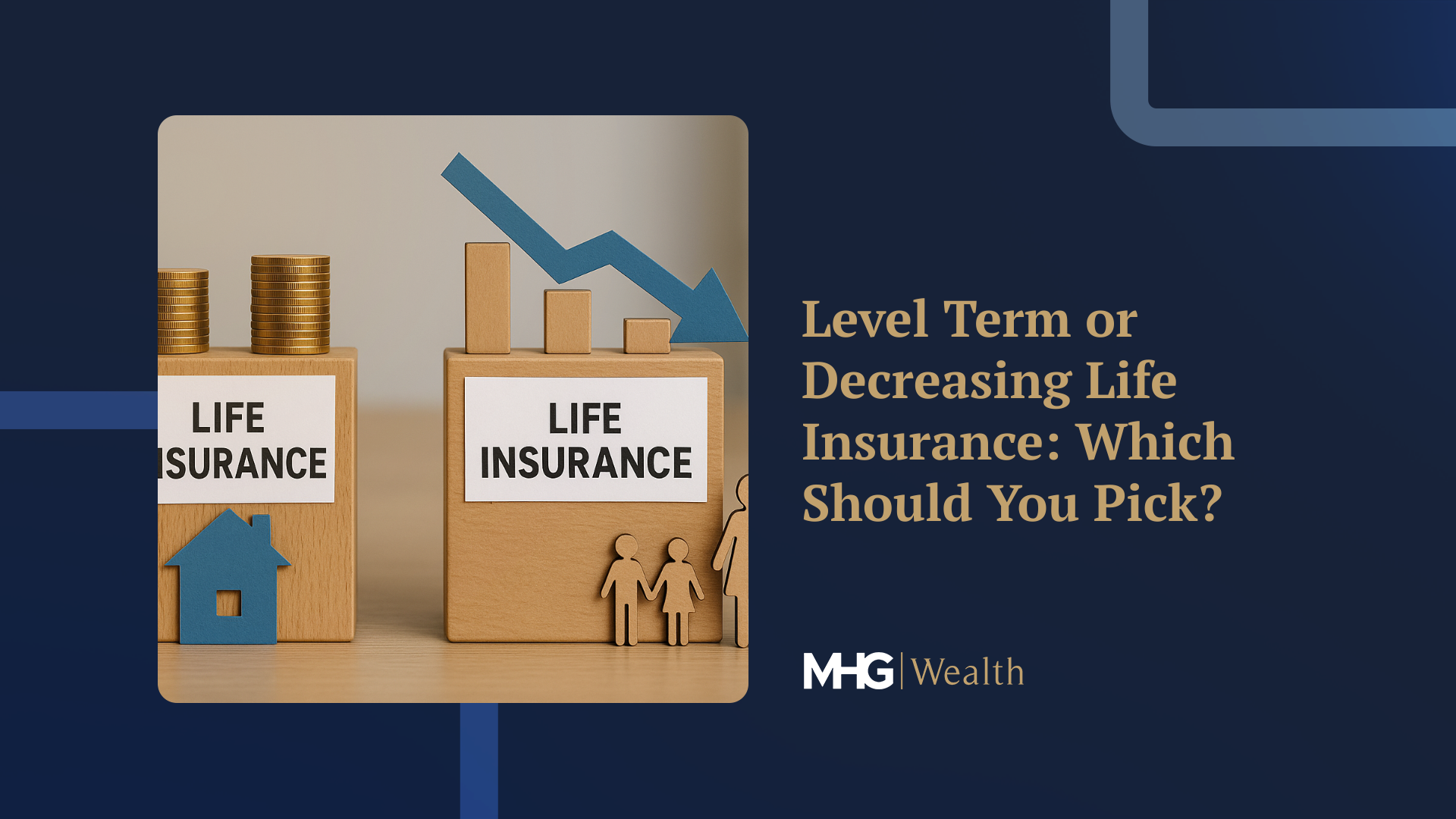
Decreasing life insurance is one of the most common ways people protect a repayment mortgage, because the cover amount can fall broadly in line with what you owe. If you’re weighing up options, it helps to understand how this differs from other types of mortgage protection—especially the situations where a decreasing policy is great value, and where it can leave a gap. For a wider overview of when cover is (and isn’t) useful, see our guide to mortgage life insurance and when it actually helps.
What is decreasing life insurance?
Decreasing life insurance (often called decreasing term insurance) is a term policy where the payout (the “sum assured”) reduces over time. You pay a fixed premium for an agreed term (for example, 25 years). If you die during the term, the policy pays out the cover amount at that point in time.
The key feature is that the cover is designed to reduce each year—typically on a pre-set schedule—so it can be aligned to a debt that also reduces, such as a repayment mortgage.
How decreasing cover typically works alongside a repayment mortgage
With a repayment mortgage, each monthly payment usually covers both interest and capital. Over time, the balance you owe falls until the mortgage is fully repaid.
In many decreasing policies, the insurer reduces the cover in a way intended to broadly match a standard capital-and-interest repayment profile (often using an assumed interest rate). The aim is simple: if the worst happens, the remaining cover can help clear the remaining mortgage balance so your family can keep the home.
A simple example (illustrative)
Imagine a 25-year repayment mortgage. A decreasing policy might start with cover close to your initial loan amount and then gradually reduce over the 25 years. In the early years—when the mortgage balance is higher—the potential payout is higher. Later, as the mortgage balance falls, the potential payout is lower.
Why decreasing life insurance can cost less
Because the insurer’s potential payout reduces over time, decreasing policies are often cheaper than level-term cover for the same starting amount and term. In plain terms, the insurer is taking less risk in the later years of the policy, and that can show up as lower premiums.
This lower cost can be especially appealing when:
- Your main goal is mortgage repayment, rather than broader income replacement.
- Your budget is tight (e.g., after moving costs or family expenses).
- You’re taking on a large mortgage and want meaningful protection without paying for a constant payout you may not need.
When decreasing life insurance may be the wrong fit
Decreasing cover is designed to mirror a reducing liability. If your need for protection won’t shrink in the same way, you can end up underinsured.
1) Interest-only mortgages
With an interest-only mortgage, your capital balance typically doesn’t reduce across the term. A decreasing policy may leave a shortfall later, because the cover will have reduced even though the mortgage balance hasn’t. In that scenario, level-term life insurance is often a closer match.
2) Broader family protection needs (not just the mortgage)
Mortgage cover is only one part of protection planning. If your family would also need money for living costs, school fees, childcare, or other long-term commitments, a policy that reduces each year may not provide enough later on.
Many families choose a blend—for example, a decreasing policy to match the mortgage and a smaller level-term policy for extra needs—so the total protection better reflects real-world costs.
3) Inflation and lifestyle costs
Even if the mortgage reduces, general living costs can rise over time. A decreasing payout can feel smaller in real terms in later years, especially if you were relying on it for more than clearing the loan.
4) If you plan to move, refinance, or extend your borrowing
If you expect to upsize, refinance, or take additional borrowing later, the cover schedule you set today may not suit your future mortgage. You may need to review the policy or add additional cover.
Decreasing vs level term: the decision framework
If you’re unsure which direction to go, ask one practical question: is the main thing I need to protect a balance that reduces over time?
- Mostly yes (repayment mortgage is the key liability): decreasing cover may be a strong fit.
- Mostly no (dependants need stable support, or debt doesn’t reduce): level-term cover is often more suitable.
- A mix: consider combining decreasing cover (mortgage) with level-term cover (family needs).
Joint or single policy for a mortgage?
If you have a partner, you’ll also need to decide whether to arrange protection on a single-life or joint-life basis. Joint policies typically pay out once (on the first death), which can be suitable if the goal is to clear the mortgage if either partner dies.
However, joint isn’t always best—especially if you want separate protection for each person, or you have different needs and budgets. For a clearer comparison, read our guide to how joint life insurance works and when it makes sense.
Key setup choices that affect whether the cover actually matches your mortgage
Match the term to the mortgage term (or remaining term)
Commonly, people set the policy term to match the mortgage term (e.g., 20, 25, or 30 years). If you’re partway through your mortgage, consider the remaining term rather than the original length.
Set the starting amount thoughtfully
Many people choose a starting cover amount equal to the mortgage balance. Others choose a little more to account for fees, a temporary buffer, or early repayment charges.
Check how the policy decreases
Not all decreasing policies reduce in exactly the same way. The reduction schedule may assume a particular interest rate or repayment profile. If your mortgage structure is unusual, or your lender terms differ, it’s worth checking how closely the cover will track your balance.
Consider adding critical illness cover (where appropriate)
Mortgage problems aren’t only caused by death. A serious illness can also disrupt income for long periods. Some people add critical illness cover so that a diagnosis triggers a payout, which can help reduce or clear the mortgage while you focus on recovery. This increases cost, so it’s typically weighed against other priorities (emergency savings, income protection, and overall budgeting).
What insurers look at (and why premiums vary)
Even though decreasing cover is a straightforward product, pricing varies based on risk factors such as age, smoking status, health history, occupation, and the term length. In many cases, you’ll complete health and lifestyle questions, and you may be asked for medical evidence depending on the amount of cover.
It can also help to compare providers consistently (policy definitions, exclusions, and claims reputation—not just price). The UK’s Financial Conduct Authority sets expectations for how insurers should treat customers and communicate products; you can see more in the FCA’s overview of insurance and protection products for consumers.
Common pitfalls to avoid
- Choosing decreasing cover for interest-only borrowing and discovering a gap later.
- Insuring only the mortgage and forgetting other liabilities or childcare/living costs.
- Setting the wrong term (e.g., shorter than the mortgage term), leaving later years unprotected.
- Not disclosing relevant medical or lifestyle information, which can lead to delays or problems at claim time.
- Assuming the cover always matches your exact mortgage balance—it’s usually an approximation.
Is decreasing life insurance a good idea for expats or cross-border families?
It can be, but the “right” structure depends on where the mortgage is held, where your family would live if something happened, and whether you also need cover for other obligations. For people arranging cover while living abroad, the availability, underwriting requirements, and policy currency can differ by market. If you’re considering protection in the UAE, our guide to term life insurance in the UAE (how it works and what it costs) can help you compare the basics.
FAQs
Does decreasing life insurance always pay off my mortgage?
Not necessarily. It’s designed to broadly track a repayment mortgage, but the cover reduction may not match your exact outstanding balance—especially if you’ve overpaid, changed rate types, extended the term, or remortgaged.
Can I switch from decreasing to level term later?
You can apply for a new policy, but it’s a new application with new underwriting, based on your age and health at the time. If your health changes, the new cover may cost more or come with exclusions. That’s why it’s worth choosing the structure carefully at the outset.
Is decreasing cover the same as mortgage payment protection insurance (MPPI)?
No. Decreasing cover is life insurance (it pays out on death during the term). MPPI is designed to cover mortgage repayments for a limited time if you can’t work due to accident, sickness, or unemployment. They address different risks.
What happens if I repay my mortgage early?
You can keep the policy (it may still provide some protection, just not tailored to a specific debt), cancel it, or replace it with cover that better fits your updated needs. Cancelling stops future premiums, but you won’t get premiums back on a standard term policy.
Bottom line
Decreasing life insurance is popular for mortgages because it’s designed to protect a reducing debt at a cost that can be lower than level-term cover. It’s often a strong match for repayment mortgages where the main goal is to keep the home secure if a partner or parent dies. But it can be the wrong fit for interest-only borrowing, or where your family needs a stable, long-term financial safety net beyond just clearing the loan.
If your needs go beyond the mortgage—income replacement, education costs, or multiple debts—consider whether a level-term policy (or a combination of covers) would better protect your family across the full term.
For impartial UK guidance on buying and using life insurance, MoneyHelper’s overview of whether you need life insurance and how it works is a helpful starting point.