
Global Portfolio Strategies In A Connected World
The financial world is vast, dynamic and full of both opportunity and risk. In 2026, interest rate shocks, inflation cycles, geopolitical tensions and rapid advances in technology all feed into how markets move across the globe. Interest rates in different countries play a huge role in attracting investment capital, as higher interest rates can draw investors seeking better returns, while also impacting currency stability and the overall returns from international investments.
Building a balanced investment portfolio across multiple countries is still one of the smartest ways to grow your wealth, reduce risk and secure your financial future. A clear global wealth management strategy helps you cut through the noise and avoid making emotional decisions every time there is a headline about markets falling or currencies moving.
But what does a truly ‘balanced’ global portfolio actually look like? And how do you navigate international markets without losing sleep over currency fluctuations, tax rules or political events in countries you have never visited?
This guide simplifies the realities of investing in multiple markets and walks you through global portfolio strategies that can support a balanced investment plan aligned with your goals.
In this article, we’re going to look at how to:
- Understand what a balanced global portfolio really is in 2026
- Build practical global portfolio strategies across regions and asset classes
- Apply a balanced portfolio example you can adapt to your own situation
Understanding Investment Portfolios
What Is An Investment Portfolio?
A balanced investment portfolio is the sum of all your financial assets, designed to meet your specific investment goals. Think of it as your financial toolbox, containing:
- Equities: Shares in companies that offer growth potential
- Bonds: Debt securities providing steady income and lower risk
- Real estate: Property investments for income and capital appreciation
- Alternative investments: Assets such as commodities, hedge funds or private equity
When you invest across several regions, this toolbox becomes an international investment portfolio or global portfolio. The principles are the same, but your risk and opportunity set now stretch across multiple currencies, regulatory regimes and economic cycles.
Key Components Of A Balanced Global Portfolio
A well balanced portfolio still rests on the same foundations, but in a global context: diversification, sensible risk management and clear objectives.
You want a combination of different asset classes so that you are not relying solely on shares, or only on bonds. You also want geographical diversification, with exposure to North America, Europe, Asia and selected emerging economies. Global diversification provides diversification benefits by reducing risk and increasing portfolio stability through exposure to different markets and economic factors. Finally, you want a mix of higher risk and lower risk assets that reflect your personal risk tolerance and financial goals.
For many investors, especially those searching for a balanced portfolio for European investors or estrategias de activos equilibrados, getting this mix right is more important than picking the perfect individual share or fund.
The Role Of Asset Allocation In Global Portfolio Management
Asset allocation is the cornerstone of portfolio management. It’s about deciding how much of your money to invest in each category, based on:
- Time horizon: Are you investing for 5 years or 30 years?
- Risk tolerance: How much volatility can you handle?
- Financial goals: Are you focused on retirement, buying property or wealth preservation?
Asset allocation decisions are also guided by your return objectives, which help tailor the portfolio to your long-term financial goals.
For example:
- A conservative investor may lean heavily on bonds and real estate
- An aggressive investor might allocate more to equities and emerging markets
In a global portfolio strategy, you’re also deciding where in the world you place those assets. A conservative investor may still own a global portfolio, but with more in developed market government bonds and large established companies, while a more aggressive investor may tilt towards emerging market shares and higher-yielding bonds.
Proper allocation ensures your portfolio is robust enough to weather market volatility while aiming for steady long-term growth. For many people, this is the practical heart of global portfolio management.
Why Diversification Matters For A Global Portfolio
Why Diversify Your Portfolio?
Diversification is like creating a safety net for your investments. If one asset underperforms, others can help offset the loss. The same logic applies to geographical diversification. By investing across multiple countries, you are not betting on a single economy or currency. The principle is simple: do not put all your eggs in one basket.
Benefits of diversification include:
- Reduced risk: If one market underperforms, gains in other regions or industries can offset losses
- More consistent returns: A blend of high growth and more stable assets can smooth performance over time
- Global opportunities: Access to high-growth sectors in emerging markets and steady earners in developed economies
A well-constructed global portfolio can feel less stressful than a concentrated local one, because it’s not driven solely by the fortunes of a single country or index. A globally diversified portfolio also allows investors to benefit when markets rise in different regions and sectors, especially during periods of global economic growth.
How Investing Across Multiple Countries Mitigates Risk
Economic cycles, political events and currency movements rarely line up perfectly across the world. While one region is slowing, another may be recovering or accelerating. By spreading your holdings, you reduce the impact of any one region experiencing:
- A recession in a developed economy
- Political instability in an emerging market
- A sector specific downturn, for example in technology or energy
Instead of listing every risk, think of your global portfolio as a series of levers. If one part of the world struggles for a period, other regions, sectors or asset classes can help keep your overall global portfolio investment on track.
Global diversification also serves as an effective risk mitigation strategy, helping to balance high- and low-risk investments and ensure portfolio stability.
Examples Of Diversified Portfolios By Region
Diversification is easier to picture when you think in regional building blocks. An investor might hold:
- North America: Tech shares such as Apple or Amazon, US Treasury bonds and real estate investment trusts (REITs). Including US stocks in a diversified global portfolio is important, as US stocks often contribute to market leadership and overall performance.
- Europe: Blue chip shares such as Nestlé, corporate bonds and ETFs tracking the FTSE 100 or other major indices
- Asia: Exposure to growth in China or India through mutual funds or ETFs
- Emerging markets: Positions in countries such as Brazil or South Africa for higher risk, higher reward opportunities
Combined properly, these become one coherent global portfolio strategy rather than a random collection of international funds.
5 Key Global Portfolio Strategies
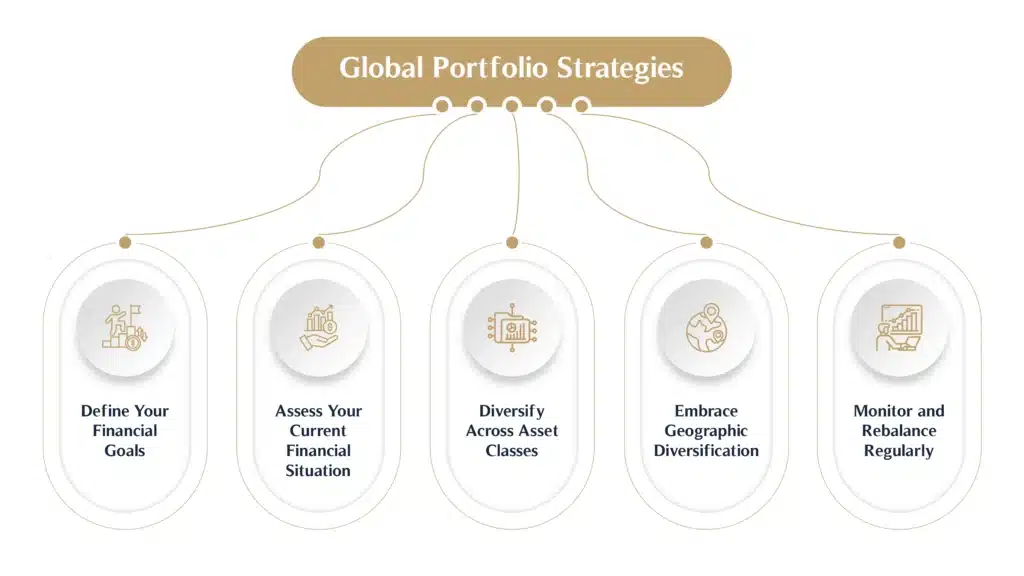
A strong global portfolio doesn’t appear by accident. It comes from a small set of sensible decisions, applied consistently over time.
These global portfolio strategies are designed to optimize potential returns by exposing investors to a wider range of opportunities across regions and sectors.
Define Your Financial Goals
Start with the end in mind. Are you saving for retirement, buying a home or building wealth to pass down to future generations? Your goals will dictate your time horizon and your appetite for risk.
If your goal is long term wealth accumulation, you might lean more towards global equities and international investments, accepting more short term volatility for higher expected returns. For shorter term goals, such as a house deposit in five years, you might prioritise bonds and cash equivalents within a more cautious global portfolio.
Knowing what you want the money for helps you decide what a balanced investment portfolio means for you personally.
Assess Your Current Financial Situation
Before you commit to a global portfolio strategy, you need to know where you stand today. Start by calculating your net worth, listing all your assets and subtracting your liabilities. Then review your monthly income and core living expenses to see how much surplus you realistically have available to invest.
Once you’ve allowed for an emergency fund, the remaining capital is what you can sensibly allocate to your global portfolios. This clarity not only guides your investment decisions, it also helps you avoid taking on more risk than your overall financial position can support.
Diversify Across Asset Classes
A balanced portfolio includes a mix of:
- Equities: For long term growth
- Bonds: For stability and income
- Real estate: For diversification and inflation protection
- Alternative investments: Such as gold or private equity, to hedge against market volatility
Each asset class behaves differently under various economic conditions, reducing the overall risk of your portfolio. When these are combined in a global context, you effectively create several layers of diversification: by asset type, by country and by sector.
This is how many professional managers design fund portfolio strategies, and the same thinking can help you structure your own balanced equity portfolio and bond holdings across different regions.
Diversifying across asset classes and regions can help improve risk-adjusted returns by balancing risk and reward.
Embrace Geographic Diversification
Do not put all your eggs in one basket, or one country. Invest across multiple regions to spread risk and tap into global growth opportunities. For example:
- North America for technology and innovation
- Europe for stable blue-chip dividends and strong consumer brands
- Asia for emerging market growth and manufacturing strength
From the perspective of international portfolio management, geographic diversification isn’t about owning a long list of random global funds. It’s about designing a global portfolio strategy where each region plays a specific role in delivering growth, income or resilience.
Monitor And Rebalance Regularly
Your portfolio will shift over time as markets fluctuate. What starts as a 50% equity allocation could grow to 60% if shares perform well. Rebalancing helps you stay aligned with your original strategy and risk tolerance.
In practical terms, this means periodically reviewing your global portfolio and trimming back positions that have grown too large, while topping up areas that have become underrepresented. In 2026, many investors use technology to support this aspect of global portfolio management, from simple alerts inside investment platforms to more advanced tools that track risk levels and regional exposures.
Regular monitoring and analytics provide the actionable data needed to make informed decisions and actively manage your global portfolio.
Managing Currency Risk In Global Portfolios
Managing currency risk is a vital part of successful global portfolio management. When you invest in assets across multiple countries, currency fluctuations can heavily influence the value of your globally diversified portfolio. Even if your investments perform well in their local markets, changes in exchange rates can either enhance returns or erode gains when converted back to your base currency.
To manage this risk, portfolio managers often use hedging strategies. Hedging involves taking positions in financial instruments, such as forward contracts, options or futures, that offset potential losses from currency movements. This approach can help stabilise returns and reduce unwanted volatility in your global investments.
Another effective way to manage currency risk is through diversification. By spreading your investments across different countries and asset classes, you reduce the impact that any single currency’s movement can have on your overall portfolio. For example, if the US dollar weakens but you also hold assets in euros, yen or emerging market currencies, the negative effect on your portfolio’s value may be lessened.
It’s also essential for investors and portfolio managers to regularly monitor exchange rates and assess how currency fluctuations are affecting their global portfolio. Adjusting your asset allocation or rebalancing your holdings in response to significant currency moves can help protect your portfolio and enhance returns over time.
Ultimately, effective currency risk management allows you to benefit from global opportunities while keeping your investment portfolio resilient against the unpredictable nature of foreign exchange markets.
Factors to Consider When Selecting International Investments
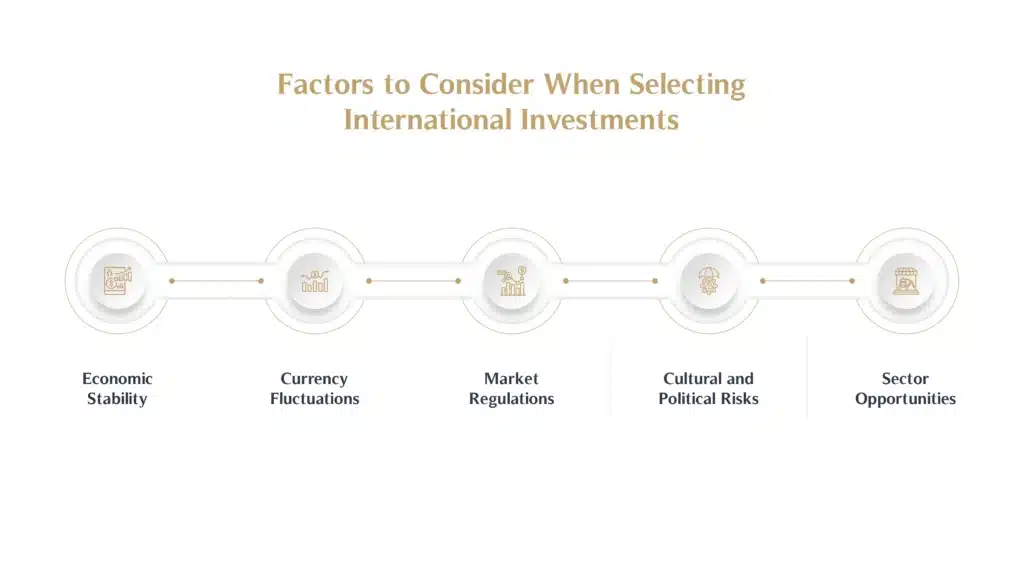
Investing globally opens up exciting opportunities, but it also comes with unique challenges. Global portfolio strategies in 2026 need to take into account not just traditional economic factors, but also the impact of technology, regulation and shifting supply chains. Here’s what to keep in mind.
Economic Stability
Research the economic health of the countries you are considering. Look for:
- Stable GDP growth
- Low and manageable inflation rates
- Reliable regulatory systems and the rule of law
Developed markets such as the US and Germany often provide stability, while emerging markets such as India and Brazil may offer higher growth potential but with greater risks. A well constructed global portfolio will usually blend both, with position sizes adjusted to your risk tolerance.
Currency Fluctuations
Investing in foreign assets means exposure to currency risk. A strong domestic currency can erode your returns from international investments, while a weaker domestic currency can amplify gains.
Diversifying currencies across your portfolio can help offset this risk. Many global funds now offer both hedged and unhedged share classes, giving you more control over how much currency exposure you want in your international investment portfolio.
Market Regulations
Different countries have varying rules around foreign investments. Instead of listing the regulations, think in terms of three questions you should always answer for any market you invest in.
First, what are the local tax rules on income, dividends and capital gains and how do they interact with your home tax system? Second, are there any restrictions or additional costs on moving money in and out of the country, including repatriating profits? Third, what reporting requirements will you face as an investor, either locally or in your home jurisdiction?
By working through these questions before you invest, you can avoid unpleasant surprises later and keep your global portfolio management clean and compliant.
Cultural And Political Risks
Political instability or major cultural shifts can impact certain industries or markets. Elections, policy changes, trade disputes or social unrest can all affect asset prices.
Staying informed about the geopolitical climate in the regions where you invest helps you decide how much to allocate and when to reduce exposure. A global portfolio strategy should reflect not just growth potential, but also how comfortable you are with the underlying political and cultural risk.
Sector Opportunities
Some regions excel in specific industries. For example:
- Asia is a hub for technology and manufacturing
- Europe leads in sustainable energy and healthcare
- The US dominates in innovation and tech start-ups
Many investors now combine regional and sector views when designing global portfolio strategies. You might use Asian and US technology for growth, European healthcare for defensiveness and global infrastructure for long-term, inflation-linked income. This type of thinking is particularly useful when you’re looking for a balanced equity portfolio that still captures global themes.
Global Market Trends Shaping Portfolio Decisions
Staying ahead of global market trends is crucial for making informed investment decisions and building a resilient portfolio. In today’s interconnected world, global markets are shaped by a range of factors that can create both risks and growth opportunities for investors.
One of the most significant trends is the rapid expansion of emerging markets. Countries in Asia, Latin America and Africa are experiencing strong economic growth, offering investors access to new markets and sectors with high return potential. However, these markets can also be more volatile, with risks such as political instability and currency fluctuations that require careful risk management.
Technology is another powerful force driving global markets. Tech stocks, particularly in the US and Asia, have become major contributors to market growth and innovation. Investing in technology-focused companies or funds can provide exposure to sectors with long-term growth prospects, but it’s important to balance this with other asset classes to manage risk.
Geopolitical events, such as trade disputes, economic recessions and changes in government policy, can also heavily influence global markets. These events can lead to increased volatility and impact the performance of specific regions or sectors. By maintaining a well-diversified portfolio that includes equities, bonds and alternative investments across multiple countries, investors can better navigate these uncertainties.
Ultimately, understanding and responding to global market trends allows investors to position their portfolios for long-term success. A diversified, multi-asset approach helps capture growth opportunities while managing the risks associated with economic cycles, currency movements and geopolitical developments.
Example Of A Balanced Investment Portfolio
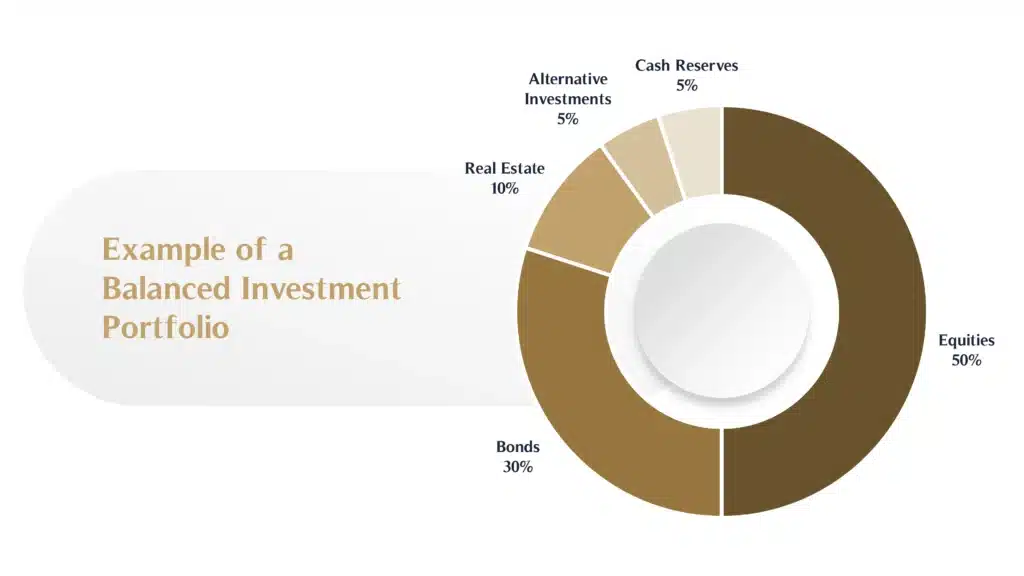
Here is a practical example of a globally diversified portfolio for a moderate risk investor. This is purely a balanced portfolio example to illustrate how a balanced investment portfolio might be structured, not personal advice.
Equities (50%)
- North America (20%): Invest in blue-chip companies such as Apple and Microsoft for stability and growth
- Europe (15%): Focus on industries such as healthcare and renewable energy
- Asia (15%): Explore emerging markets ETFs, targeting technology and infrastructure sectors
Bonds (30%)
- UK government bonds (15%): For stability and predictable income
- Global corporate bonds (15%): Higher yields with moderate risk
Real Estate (10%)
- Commercial property funds (5%): Invest in high-demand markets such as London or Frankfurt
- Residential real estate (5%): Focus on rental properties in stable economies
Alternative Investments (5%)
- Gold ETFs (3%): Hedge against inflation
- Private equity funds (2%): High growth potential over the long term
Cash Reserves (5%)
Held in multiple currencies for quick liquidity and flexibility. This also provides optionality if markets fall and you want to add to your global portfolio at more attractive valuations.
This kind of balanced investment portfolio not only spreads risk but also ensures exposure to high growth opportunities across the globe. It illustrates how a balanced portfolio strategy can sit at the centre of global portfolio management for European investors, with the flexibility to tilt more cautiously or aggressively around this core.
Example of a Balanced Investment Portfolio (Graph)
Avoiding Common Mistakes In Global Portfolio Management
Avoiding common mistakes is essential for building a robust and resilient global portfolio. One of the most frequent errors investors make is failing to diversify adequately. Relying too heavily on one country, sector or asset class can expose your portfolio to unnecessary risk and limit the benefits of global diversification.
Another common pitfall is overlooking the impact of currency fluctuations. Currency risk can significantly affect the value of your investments, especially when markets are volatile. Proactive currency risk management, through hedging or diversification across multiple countries, can help protect your portfolio from unexpected losses.
It’s also important not to focus too narrowly on a single region or market. While it may be tempting to concentrate investments in familiar markets, this approach can leave your portfolio vulnerable to local downturns or sector-specific challenges. Instead, aim for a globally diversified portfolio that includes developed markets, emerging markets and a mix of asset classes such as equities, bonds, private equity and hedge funds.
Emotional decision-making is another trap to avoid. Reacting to short-term market volatility or news headlines can lead to poor investment decisions and disrupt your long-term strategy. Successful portfolio management requires discipline, a clear understanding of your risk profile and regular rebalancing to maintain your desired asset allocation.
By steering clear of these common mistakes and focusing on the key components of a globally diversified portfolio, investors can reduce risk, enhance return potential and build a portfolio that stands up to the challenges of global markets.
Key Takeaways For Your Global Portfolio Strategy
- A thoughtful global portfolio strategy builds diversification across asset classes, regions and currencies, not just a long list of funds
- Successful global portfolio management in 2026 relies on clear goals, sensible risk levels, regular rebalancing and a balanced equity portfolio that fits your life stage
- A balanced investment portfolio using global portfolio strategies can help you capture worldwide growth while still controlling risk and volatility over the long term
Working With MHG Wealth On Global Portfolio Management
Building a balanced investment portfolio across multiple countries is a rewarding strategy that requires careful planning. By diversifying geographically, allocating assets strategically and staying informed about global trends, you can create a resilient portfolio that grows with you.
At MHG Wealth, we specialise in helping investors like you build customised portfolios tailored to your financial goals. Whether you’re just starting out or looking to optimise an existing portfolio, our advisors are here to guide you every step of the way.
Ready to invest globally? Contact one of our investment advisors to take the first step toward financial freedom.
FAQ About Global Portfolio Management
How do you start building a global portfolio from scratch?
You start by clarifying your goals, time horizon and risk tolerance, then setting a simple target allocation between equities, bonds, property and alternatives. From there, choose a small number of broad, low-cost global funds or ETFs that give exposure to major regions such as North America, Europe and Asia. As your confidence grows, you can refine your global portfolio strategy with more specific regional or sector positions.
How often should you rebalance a global portfolio?
Most individual investors review and rebalance their global portfolios once or twice a year, or when positions drift significantly away from their target weights. The key is to have a clear set of rules, rather than reacting emotionally to every market move. Regular, rules-based rebalancing is a core part of disciplined global portfolio management.
What is the main difference between a domestic and a global portfolio?
A domestic portfolio is focused on investments in your home country, while a global portfolio spreads your holdings across multiple countries and currencies. A global approach usually improves diversification and can reduce reliance on a single economy or currency, although it does introduce extra considerations such as currency risk and foreign tax rules.
Can a balanced equity portfolio still be global?
Yes. A balanced equity portfolio simply means your equity holdings are spread sensibly across sectors, styles and regions, rather than concentrated in one area. Many investors hold a mix of global equity funds that together cover developed and emerging markets, giving them a diversified equity base within a broader balanced investment portfolio.
Are global portfolio strategies suitable for cautious investors?
Global portfolio strategies can be adapted for cautious investors by increasing the share of high-quality bonds and cash, and by focusing equity exposure on larger, more stable companies and developed markets. The aim is not to avoid international exposure, but to size it appropriately so that the overall global portfolio investment still feels comfortable during market declines.